The Aa is a tributary of the Kleine Nete in the basin of the Scheldt, in the Belgian province of Antwerp.
The Aa is formed by the drainage of the area north of Turnhout: the Nattenloop and the Wouwerloop merge south of Ravels. A little further on, it receives the drainage of the nature reserve "De Liereman" and flows via Oud-Turnhout east and south around Turnhout, just outside the city ring road (Parklaan R13). Via the ponds of the city park, it then bends south-west where it receives the Visbeek that drains the west of Turnhout and flows further towards Gierle. Beyond the road from Tielen to Gierle, it is powerful enough to power the centuries-old water mill of Tielen. It is located on an island between two branches that are also called the Old and the New Aa. A little further on the border of Tielen and Poederlee, it receives its largest tributary: the Grote Kaliebeek, which ensures the drainage of the Balderij, a wetland area between Tielen and Zevendonk. Near Lille it receives from the north the Laakbeek (from the Gielsbos) and beyond Sassenhout the Bosbeek, also called Kindernouwbeek and Visbeek (east of Wechelderzande). It flows close to the Kempen dune ridge, between Grobbendonk and Kasterlee. The Aa flows into the Kleine Nete at the historic watermill of Grobbendonk. The valleys of Aa and Kleine Nete together form a contiguous green area, with the Schupleer nature reserve at its heart.
The river forms the municipal border between Lille (Gierle) and Kasterlee (Tielen), between Lille (Poederlee) and Kasterlee (Tielen), between Lille (Poederlee) and Vorselaar, between Vorselaar and Herentals, and between Vorselaar and Grobbendonk.
In the valley of the Aa, iron ore or 'iron mill' used to be mined. This then had to be taken to unloading points on the Kleine Nete. To achieve this, several canals were dug between the Aa and the Nete. From the 70s of the twentieth century, the valley was "poldered" for agricultural purposes: the river was straightened and dammed. To regulate the water level, sluices were built and the meadows were drained. The land consolidation changed the landscape profoundly: straight streets and ditches and large open plots. The scarce remnants of the original landscape, mostly recreational areas with a more or less illegal character, have been given more and more protected status in recent decades.
 Azure
Azure | | Public | Danish • Dutch • French • German • Italian • Spanish
Address: Herentals
Statistics
Select one of the most popular activities below or refine your search.
Discover the most beautiful and popular trails in the area, carefully bundled into appropriate selections.
Source: http://nl.wikipedia.org/wik...
Select one of the most popular categories below or be inspired by our selections.
Discover the most beautiful and popular attractions in the area, carefully bundled in appropriate selections.
Source: http://nl.wikipedia.org/wik...
With RouteYou, it's easy to create your own customised maps. Simply plot your route, add waypoints or nodes, add places of interest and places to eat and drink, and then easily share it with your family and friends.
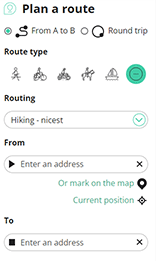
Route planner
<iframe src="https://plugin.routeyou.com/poiviewer/free/?language=en&params.poi.id=1733514" width="100%" height="600" frameborder="0" allowfullscreen></iframe>

More than 11,800,000 routes

More than 15,000,000 users

More than 4,500,000 points of interest

Kerkstraat 108
9050 Gentbrugge, Belgium
© 2006-2026 RouteYou - www.routeyou.com