Source: Hooft, Elise, 01-01-2003, ©Vlaamse Gemeenschap
Copyright: All rights reserved


New Steenweg nr. 128/ Draaiboomstraat. Farm "De Draaiboom", formerly "Ten Grooten Boomgaard". Historical farm at the corner of New Steenweg and Draaiboomstraat, the latter named after the farm. First mentioned in 1437 as a moated farm "ten groten boghaerde", the property of the Carthusians. Indicated on the map of P. Pourbus from 1561-1571 as a large, moated farm. In 1690 still under the same name "An d'hofstede daer Joos Nieuwmunster op woont mette walgracht rontsomme"; a map from the same date shows us one volume under gable roof, identifiable as the core of the current farmhouse. From the late 18th century known by the current name: "the huele laying in the Zielestraete against the foot of the farmstead called den Draeyboom inhabited by Emanuwel Meermeuys" (1788). On the Ferraris map (1770-1778) indicated as three separate volumes, two of which are perpendicular to each other. On the Atlas der Buurtwegen (ca. 1845), this arrangement is recognizable, albeit with larger volumes and to the east a smaller building: indicated on this map with the name "Ferme Draeiboom". The three buildings can be identified as the farmhouse (west, ridge perpendicular to the street) with incorporated stables on both sides and a stable/barn volume perpendicular to it; likely behind it a bakery annex summer kitchen. In 1871, renovations are made to both perpendicular volumes, replacing the barn as well as the stable sections on both sides of the farmhouse. In 1874 the elongated rear volume is demolished and replaced by an extension to the farmhouse. In 1937 the barn is expanded to the east and the volumes are connected in an L-shape. In 1953 smaller separate stables are built behind the house. In 1991, a concrete shed is added on the east side of the yard. Farm with detached components of anchored brick under tiled gable roofs, of which only the farmhouse with two raised ridge sections is whitewashed. The farm is accessible via a long driveway, and the buildings are arranged on three sides of a grazed yard; the older buildings form an L. The farmhouse is the only volume retained in the 19th-century renovations. LAND REGISTRY ARCHIVE WEST FLANDERS IN BRUGES, Mutation sketches Zuienkerke, 1871/6, 1874/8, 1937/13, 1953/21, 1991/16. STATE ARCHIVE BRUGES, Watering of Blankenberge, no. 406. STATE ARCHIVE BRUGES, Ommelopers Peper, no. 491. BOTERBERGHE R., Zuienkerke. History of a polder village, Zuienkerke, 1992, p. 265, 284, 389. DE FLOU K., Dictionary of toponymy, Ghent, 1924, fourth part, column 1095.
Source: Callaert, Gonda & Hooft, Elise
Copyright: All rights reserved
 | | Public | Danish • Dutch • French • German • Italian • Spanish
Address: Nieuwe Steenweg 128, Zuienkerke
Statistics
Select one of the most popular activities below or refine your search.
Discover the most beautiful and popular trails in the area, carefully bundled into appropriate selections.
Source: Hooft, Elise, 01-01-2003, ©Vlaamse Gemeenschap
Copyright: All rights reserved
Select one of the most popular categories below or be inspired by our selections.
Discover the most beautiful and popular attractions in the area, carefully bundled in appropriate selections.
Source: Hooft, Elise, 01-01-2003, ©Vlaamse Gemeenschap
Copyright: All rights reserved
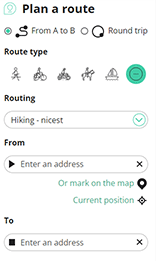
With RouteYou, it's easy to create your own customised maps. Simply plot your route, add waypoints or nodes, add places of interest and places to eat and drink, and then easily share it with your family and friends.
Route planner
<iframe src="https://plugin.routeyou.com/poiviewer/free/?language=en&params.poi.id=3157163" width="100%" height="600" frameborder="0" allowfullscreen></iframe>

More than 10,100,000 routes

More than 15,000,000 users

More than 4,500,000 points of interest

Kerkstraat 108
9050 Gentbrugge, Belgium
© 2006-2026 RouteYou - www.routeyou.com