The southern Brackvenn is a vast area of heath and bogs extending at an altitude of 610-620 m to the east of the Hautes-Fagnes plateau, between Eupen and the small German town of Monschau. The site contains one of the last three active raised bogs in the region, known as Misten. Indeed, there remains a large peat mass whose center reaches 7.8 m in thickness. This bog, of which the active part still covers about twenty hectares, occupies a very particular topographical location, on an irregular flat top, overlooking everything around it, except on the southeast side where it ends at the bottom of a slope. For several decades, it has been the subject of research interested in climate evolution during the Quaternary through palynology and the study of plant fragments buried in the peat layers. In the past, part of the site experienced semi-industrial peat extraction activity, traces of which are still visible today, such as the significant straight drainage ditch that crosses the bog from north to south, the Eupener Graben. The flora of Brackvenn is of exceptional interest because it brings together most of the plant species characteristic of raised bogs, including many rare sphagnums as well as the cotton grass (Eriophorum vaginatum), the heath (Erica tetralix), the andromeda (Andromeda polifolia), the cranberry (Vaccinium oxycoccos), the bog asphodel (Narthecium ossifragum), etc. There are also some patches of bare peat colonized by the very rare white rhynchospore grouping (Rhynchospora alba) and round-leaved sundew (Drosera rotundifolia). The area located east of the ditch, where peat was exploited, is covered by degraded bog vegetation dominated by moor grass (Molinia caerulea) and heathlands of Ericaceae. Since 2007, significant restoration work has been carried out on the Misten, particularly as part of the LIFE Hautes-Fagnes project, which has led to the reconstruction of dystrophic water bodies that are rapidly evolving into pioneer habitats of raised bogs, rich in sphagnums and of great importance for avifauna and odonates, allowing prestigious species such as the subarctic darner (Aeshna subarctica), the Arctic emerald (Somatochlora arctica), or the winter teal (Anas crecca) to breed there.
Type: Site of Great Biological Interest (SGIB)
 | | Public | Danish • Dutch • French • German • Italian • Spanish

Select one of the most popular activities below or refine your search.
Discover the most beautiful and popular trails in the area, carefully bundled into appropriate selections.
Source: jeroenrozema74
Copyright: Creative Commons 4.0
Select one of the most popular categories below or be inspired by our selections.
Discover the most beautiful and popular attractions in the area, carefully bundled in appropriate selections.
Source: jeroenrozema74
Copyright: Creative Commons 4.0
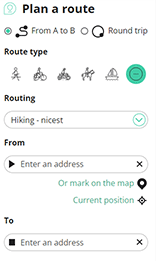
With RouteYou, it's easy to create your own customised maps. Simply plot your route, add waypoints or nodes, add places of interest and places to eat and drink, and then easily share it with your family and friends.
Route planner
<iframe src="https://plugin.routeyou.com/poiviewer/free/?language=en&params.poi.id=7303654" width="100%" height="600" frameborder="0" allowfullscreen></iframe>

More than 11,800,000 routes

More than 15,000,000 users

More than 4,500,000 points of interest

Kerkstraat 108
9050 Gentbrugge, Belgium
© 2006-2026 RouteYou - www.routeyou.com