Source: IJzerzandsteen


The 'Flemish Ardennes' belong to the hill range from 50 m to 150 m high that stretches from the Heuvelland (Kemmelberg, ...), over the Flemish Ardennes (Kluisberg, Muziekberg, ...) to the Pajottenland (Bosberg, ...) and the Hageland.
These hills are witness hills: accents in the relief that testify to a landscape that was once a lot higher. Their geological history begins during the Tertiary, about 70 to 3 million years ago. Flanders is then located in the sea and the Ardennes are a plain with rivers that flow into it. In the Diestiaan Sea (7 million years ago), sandbanks are deposited that are aligned parallel to the coast.
During the Alpine mountain formation, the Alps are raised to a high mountain range. The plain of the Ardennes is lifted into a high plateau and Flanders rises above the sea. Due to river erosion, Flanders is then sanded back into a plain. But the sandbanks of the Diestiaan Sea contain iron sandstone. These iron-rich peaks offer resistance to erosion, leaving the sandbanks as witness mounds in the landscape.
 Azure
Azure
Select one of the most popular activities below or refine your search.
Discover the most beautiful and popular trails in the area, carefully bundled into appropriate selections.
Source: IJzerzandsteen
Select one of the most popular categories below or be inspired by our selections.
Discover the most beautiful and popular attractions in the area, carefully bundled in appropriate selections.
Source: IJzerzandsteen
With RouteYou, it's easy to create your own customised maps. Simply plot your route, add waypoints or nodes, add places of interest and places to eat and drink, and then easily share it with your family and friends.
Route planner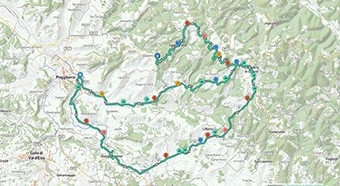
<iframe src="https://plugin.routeyou.com/poiviewer/free/?language=en&params.poi.id=7494401" width="100%" height="600" frameborder="0" allowfullscreen></iframe>

More than 11,800,000 routes

More than 15,000,000 users

More than 4,500,000 points of interest

Kerkstraat 108
9050 Gentbrugge, Belgium
© 2006-2026 RouteYou - www.routeyou.com


 | | Public |