Source: Willem Vandenameele
This small oratory, dedicated to the Virgin, stands on a hill on the edge of the village and dates back to the 18th century, or even earlier.
As is often the case, history is lost in legend when it comes to the chapel's origins... A shepherd or a monk from the Abbey of Bure is said to have found a statuette of the Virgin Mary on the Hill of Haurt carrying the baby Jesus in her arms. He brought it back to the village and the statuette was placed in the church with veneration. But - surprise! - the statue disappears and is returned to its place on Haurt's Hill . The story is repeated several times before one understands: Our Lady wants to be venerated in Haurt.
A cross is erected (1751), with a niche protecting the statue of the Virgin Mary. Stylistically, the statue seems older than the cross. It bears some resemblance to that at Foy-Notre-Dame (17th century). The phenomenon of the 'Miraculous Virgin' quickly became known in the region and pilgrims soon visited the hill to invoke 'Our Lady of Haurt'.
There was already a chapel there in 1778, as can be seen on the map of the Austrian Netherlands that Ferraris made. It was built with stones left over from the village destroyed by the Lorraine troops and was named Nives .
Like all places of worship, the chapel suffered under the French revolutionary regime . The image was insulted and the chapel was closed. In 1803, as soon as a new religious freedom allowed, the pilgrims returned to Haurt. The chapel was restored and the area was redecorated.
Because the old road was a detour to reach the chapel, a new, more direct path was built in 1850, lined with trees. The number of pilgrims grew. A wooden portal was built in front of the chapel to protect visitors from the weather. In 1921, two bays were added to the building, thereby enlarging it, and the bell tower was moved to stand above the entrance door.
For a Marian Congress in 1935, the site was redesigned to accommodate more visitors. A straight path of 800 meters long with a height difference of 50 meters replaced the old path. The Way of Seven Sorrows illustrates seven scenes with Mary from the Stations of the Cross, which has 14 stations.
Source: Willem Vandenameele - Wikipedia
 | | Public | Catalan • Danish • Dutch • French • German • Italian • Spanish

Select one of the most popular activities below or refine your search.
Discover the most beautiful and popular trails in the area, carefully bundled into appropriate selections.
Source: Willem Vandenameele
Select one of the most popular categories below or be inspired by our selections.
Discover the most beautiful and popular attractions in the area, carefully bundled in appropriate selections.
Source: Willem Vandenameele
With RouteYou, it's easy to create your own customised maps. Simply plot your route, add waypoints or nodes, add places of interest and places to eat and drink, and then easily share it with your family and friends.
Route planner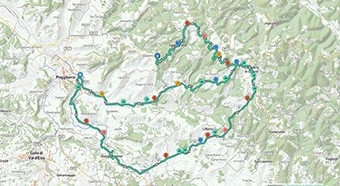

<iframe src="https://plugin.routeyou.com/poiviewer/free/?language=en&params.poi.id=8436208" width="100%" height="600" frameborder="0" allowfullscreen></iframe>

More than 11,800,000 routes

More than 15,000,000 users

More than 4,500,000 points of interest

Kerkstraat 108
9050 Gentbrugge, Belgium
© 2006-2026 RouteYou - www.routeyou.com