Source: Pascal Brackman


On the path, you can see a light yellow, beige sand appearing. Try to take it between your fingers. That sand has a link with the fact that there is a forest here.
Although forests used to grow everywhere, forests are no longer incidental in most places. Most forests were cleared in Flanders. But in places where it was difficult to grow anything else, the forest was left standing or they would reforest it because it would still yield something. Therefore, always check the substrate in forests. Sometimes you encounter very moist grounds (for example, in stream forests or alder swamps), but that is certainly not the case here. Sometimes you find very dry sands there. And that is the case here. The sands you encounter here are too permeable. Check the surrounding fields later. There is usually still a nutrient-rich clay layer on top of them. Here, that layer has disappeared or was never deposited. That clay layer can hold moisture and nutrients better. But this sand cannot. So, it is certainly no coincidence that there is a forest here and that this land was not converted into arable land.
Source: Pascal Brackman
 | | Public | Danish • Dutch • French • German • Italian • Spanish

Select one of the most popular activities below or refine your search.
Discover the most beautiful and popular trails in the area, carefully bundled into appropriate selections.
Source: Pascal Brackman
Select one of the most popular categories below or be inspired by our selections.
Discover the most beautiful and popular attractions in the area, carefully bundled in appropriate selections.
Source: Pascal Brackman
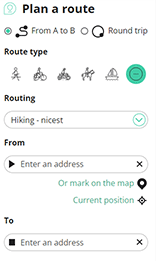
With RouteYou, it's easy to create your own customised maps. Simply plot your route, add waypoints or nodes, add places of interest and places to eat and drink, and then easily share it with your family and friends.
Route planner
<iframe src="https://plugin.routeyou.com/poiviewer/free/?language=en&params.poi.id=8982260" width="100%" height="600" frameborder="0" allowfullscreen></iframe>

More than 11,800,000 routes

More than 15,000,000 users

More than 4,500,000 points of interest

Kerkstraat 108
9050 Gentbrugge, Belgium
© 2006-2026 RouteYou - www.routeyou.com