Kasteel Lage is a castle in the Diocese of Utrecht on the northwestern edge of the municipality of Lage in the Lower Saxony Samtgemeinde Neuenhaus in the district of Grafschaft Bentheim.
In 1183, Lage Castle was mentioned for the first time in the possession of the diocese of Utrecht, which held ecclesiastical supremacy over the Lower County of the County of Bentheim and also had extensive possessions there. The hereditary office of castellan of Lage was held by the Lords of Saterslo, who were called Lords of Lage from the beginning of the 14th century. In 1270, at the same time as his appointment as castellan, Hermann von Saterslo was ordered to remain "in superiore domo" in the bishop's absence, probably in the castle tower. In addition, the same document mentions a mill in the castle. Between 1324 and 1326, the castle was destroyed by Bishop Ludwig II of Münster during the Bredevoort feud. In 1329/30, the bishop of Utrecht, John IV of Arkel, rebuilt the castle and handed it over to his ally Hermann von Lage. He sold it to Bishop John IV in 1346. Because he could not pay the purchase price, the von Lage family continued to live in the castle. In 1380, Bishop Florenz von Wevelinghoven destroyed the castle. Moreover, the castle was pledged to Reinhold von Coevorden in 1377, the pledge was only redeemed in 1445. After that, the badly neglected complex was repaired in 1447 by Bishop Rudolf von Diepholz. Lage was the episcopal seat of the ministry and was manned by a drosten. When the bishop of Utrecht, Henry of Bavaria, had to relinquish his temporal power to Emperor Charles V in 1526, Lage Castle also changed hands. In 1531, Charles promised to repair the castle and occupy it with enough men. In 1576, King Philip II of Spain, as the new owner, pawned the castle to Dietrich von Ketteler and lent him it at the same time. In 1591/92 a new building was built in the form of a fortress, which was destroyed in 1626 during the Spanish-Dutch War by the Dutch led by Ernst Casimir of Nassau. In 1634 the pledged property of Lage was transferred to Johann von Raesfeld zu Twickel near Delden and converted into a hereditary fiefdom. The castle ruins and the nearby manor house from 1686 remained in the possession of the respective owners of Haus Twickel until 1953, when the properties of the local van Heeckeren van Wassenaer family were transferred to a foundation.
Source: Wikipedia.org
Copyright: Creative Commons 3.0
 Azure
Azure | | Public | Danish • Dutch • French • German • Italian • Spanish

Select one of the most popular activities below or refine your search.
Discover the most beautiful and popular trails in the area, carefully bundled into appropriate selections.
Source: Castritus
Copyright: Creative Commons CC BY-SA 4.0
Select one of the most popular categories below or be inspired by our selections.
Discover the most beautiful and popular attractions in the area, carefully bundled in appropriate selections.
Source: Castritus
Copyright: Creative Commons CC BY-SA 4.0
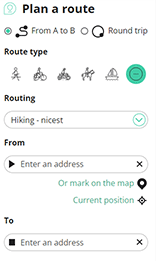
With RouteYou, it's easy to create your own customised maps. Simply plot your route, add waypoints or nodes, add places of interest and places to eat and drink, and then easily share it with your family and friends.
Route planner
<iframe src="https://plugin.routeyou.com/poiviewer/free/?language=en&params.poi.id=8348344" width="100%" height="600" frameborder="0" allowfullscreen></iframe>

More than 11,800,000 routes

More than 15,000,000 users

More than 4,500,000 points of interest

Kerkstraat 108
9050 Gentbrugge, Belgium
© 2006-2026 RouteYou - www.routeyou.com