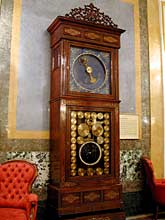
The Astronomical Clock of Billeter in the Congress of Deputies.
Introduction:
At the end of the 19th century, facing the growth of Gràcia, the owners of Can Pardal decided to urbanize their lands and demolish the farmhouse to build the building we see today with a porticoed gallery and a tower with a clock and bells. However, it seems that before this farmhouse was demolished, it housed an illustrious character: Albert Billeter, a Swiss clockmaker, who settled in Gràcia for almost thirty years.
Content:
"Factory of Tower Clocks for Churches, Railways, Factories and country houses. Watch Clocks, Electric Telegraphs and Scientific apparatus," was the name used by the Swiss Albert Billeter to advertise his establishment. Billeter had come from La Chaux-de-Fonds in Switzerland, where he studied watchmaking, passed through Italy, and ended up in the Villa of Gràcia. The first thing he did upon arrival was to create a large astronomical clock that showed the movement of the earth and the moon in relation to the sun, provided the local time and that of 20 other meridians, among other data. Without hesitation, Billeter sent a letter to the Congress of Deputies in Madrid in which, after pointing out that it was necessary to develop "national clockmaking" so that Spain would not depend on foreign countries, he offered the astronomical clock in exchange for a sum of money that would allow him to open a permanent workshop. Congress purchased the clock, which still works and is located in the Palace of Congress. It must have been quite a sensation because, shortly afterwards, the other chamber of representatives, the Senate, commissioned Billeter to create an even larger astronomical clock. Billeter took almost ten years to complete it and, with the political upheavals of the time, the Senate lost interest, and the clock was left without a buyer. Over time, it came into the hands of the Moragues family of carpenters, who created the cabinet for the clock. When Billeter was no longer in Barcelona, the clock was exhibited in the Palace of Sciences at the Universal Exhibition of 1888, where it won a gold medal. Later, it was acquired by the Royal Academy of Sciences and Arts of Barcelona, which still possesses it. Billeter was also the author of the clock of the Bell Tower of Gracia, which was changed in 1929 when it was moved to the hotel in Plaza España that served as the entrance to the site of that year's Universal Exhibition. In 1952, it was dismantled from the hotel and has since been lost track of. In 1865, Billeter built, at the request of the City Council, the clock of the Cathedral of Barcelona, which is still in operation.
More information:
Eduard Farré Olivé (1996): Alberto Billeter, a Swiss clockmaker in Barcelona. (1st part) "Art and Time" n. 121-H/4, Nov-Dec, p. 12-18. (2nd part) "Art and Time" n. 122H5, Jan-Feb 1997, p. 6-11.
 | | Public | Danish • Dutch • French • German • Italian • Spanish

Select one of the most popular activities below or refine your search.
Discover the most beautiful and popular trails in the area, carefully bundled into appropriate selections.
Select one of the most popular categories below or be inspired by our selections.
Discover the most beautiful and popular attractions in the area, carefully bundled in appropriate selections.
With RouteYou, it's easy to create your own customised maps. Simply plot your route, add waypoints or nodes, add places of interest and places to eat and drink, and then easily share it with your family and friends.
Route planner

<iframe src="https://plugin.routeyou.com/poiviewer/free/?language=en&params.poi.id=4424040" width="100%" height="600" frameborder="0" allowfullscreen></iframe>

More than 11,800,000 routes

More than 15,000,000 users

More than 4,500,000 points of interest

Kerkstraat 108
9050 Gentbrugge, Belgium
© 2006-2026 RouteYou - www.routeyou.com