The place name has an Old Dutch origin. The earliest mention is from 1163 as Hundescot.[2] It concerns a compound of the words dog and schote. The name could be derived from a personal name with the suffix schot (land surrounded by marshes on both sides).[3] But it is more likely that the part 'dog' is derived from 'hont' or dog [4]: a surface measure the size of a hundred rods. So a piece of land or terrain, surrounded by marsh on both sides, tapering and with an area 1 hon(d)t large (one hundred square rods).
History
In the Middle Ages, it was part of the County of Flanders and subsequently of the Burgundian and Spanish Netherlands. In the 16th century, Hondschote was known for its textile industry. Especially sateen (light, twill woolen cloth) was made and processed here. The town and its weavers formed the focal point of the Calvinist rebellion that broke out in the 1560s in the West Quarter. During the Eighty Years' War, Hondschote sided with the rebels after the Spanish Fury (1572).[5]
From 1528 to 1569, production rose from 28,000 to 90,000 pieces. In 1562, the sateen hall was opened and in 1570 the cloth hall was inaugurated.
In 1582, Hondschote was occupied and partially destroyed by Spanish troops, led by the Duke of Anjou. Many textile workers and textile barons then moved to Antwerp and Leiden. Negotiations were held with the city council of Leiden (until then one of the largest competitors) to come to Leiden as a group. In 1585, Antwerp was also occupied by the Spaniards (Fall of Antwerp) and the residents of Hondschote who had settled in Antwerp moved to Leiden. Potters also moved to Leiden and introduced the new pottery art to Leyden.

Hondschote in the first half of the 17th century (image from Flandria Illustrata - 1641)
Hondschote was annexed by France in 1668 as a result of the Treaty of Aix-la-Chapelle. Again, some sateen weavers moved to Bruges. By 1764, no sayen-douck was produced in the town, and the sateen hall was abolished in 1773. Hondschote is known for the Battle of Hondschote, which took place here in 1793 between soldiers of the young French Republic and a military force assembled in Flanders, consisting of British, Hanoverian, and Austrian troops. The allies were defeated, and the survival of the French Republic was secured.
Jacob Peyt, a popular runner from the 14th century, is said to have been born in Hondschote.
Geography
As of January 1, 2022, the area of Hondschote was 23.66 square kilometers; the population density at that time was 169.5 inhabitants per km².
Source: wikipedia
 | | Public | Danish • Dutch • French • German • Italian • Spanish

Select one of the most popular activities below or refine your search.
Discover the most beautiful and popular trails in the area, carefully bundled into appropriate selections.
Select one of the most popular categories below or be inspired by our selections.
Discover the most beautiful and popular attractions in the area, carefully bundled in appropriate selections.
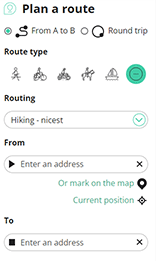
With RouteYou, it's easy to create your own customised maps. Simply plot your route, add waypoints or nodes, add places of interest and places to eat and drink, and then easily share it with your family and friends.
Route planner
<iframe src="https://plugin.routeyou.com/poiviewer/free/?language=en&params.poi.id=9261704" width="100%" height="600" frameborder="0" allowfullscreen></iframe>

More than 11,800,000 routes

More than 15,000,000 users

More than 4,500,000 points of interest

Kerkstraat 108
9050 Gentbrugge, Belgium
© 2006-2026 RouteYou - www.routeyou.com