Source: Pascal Brackman
The Fréjus Tunnel (also known as the Mont-Cenis Railway Tunnel) is approximately 13.7 km long and connects Modane (France) with Bardonecchia (Italy).
Construction started in 1857 and the tunnel was officially inaugurated in 1871; regular train service began shortly thereafter.
This tunnel is considered the first major railway tunnel bored straight through the Alpine range, and thus the first “major Alpine crossing” by rail.
The geomorological history of the region created an opportune situation for the construction of this tunnel.
The Arc Valley and the area around the Fréjus Tunnel form an almost ideal route: first deeply carved out by glaciers, then further incised by rivers on both the French and Italian sides.
During the ice ages, mighty valley glaciers filled the Arc Valley and the Susa Valley on the Italian side, deeply eroding both valleys into deep U-valleys.
This glacial erosion had already significantly lowered the relief in the valley axes relative to the surrounding mountain ridges, thereby reducing the elevation difference that still had to be overcome through a tunnel later on.
After the ice retreated, river erosion took over: the Arc on the French side and the Dora Riparia (and further downstream the Po) on the Italian side deepened the existing U-valleys even further, but within an already “preformed” glacially scoured gully.
This combination of glacial and fluvial erosion created a relatively low-lying, elongated “gully” running straight through the Alps, with a limited remaining rock massif on the watershed that had to be pierced by a tunnel.
The Fréjus Tunnel broadly follows the line from Modane to Bardonecchia, precisely where the valleys lowered by glaciers and rivers bend closest to each other beneath the main ridge of the Alps.
Because the valley floors were already so deep, the tunnel could be constructed relatively high above sea level, yet still beneath the ridge, so that the length, the required elevation difference, and the pressure and ventilation problems remained more limited than in an even rougher, less eroded mountain range.
The deep valleys offered flat, accessible starting points (Modane, Bardonecchia) with sufficient space for construction installations, railway lines, and logistics, something that would have been much more difficult in a less eroded mountain range.
The tectonic structure of this zone – part of the western Alps with relatively well-mapped units and largely crystalline and metamorphic rocks – resulted in predominantly stable tunnel land.

Select one of the most popular activities below or refine your search.
Discover the most beautiful and popular trails in the area, carefully bundled into appropriate selections.
Source: Pascal Brackman
Select one of the most popular categories below or be inspired by our selections.
Discover the most beautiful and popular attractions in the area, carefully bundled in appropriate selections.
Source: Pascal Brackman
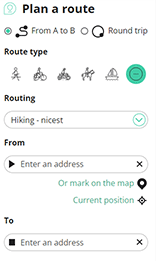
With RouteYou, it's easy to create your own customised maps. Simply plot your route, add waypoints or nodes, add places of interest and places to eat and drink, and then easily share it with your family and friends.
Route planner
<iframe src="https://plugin.routeyou.com/poiviewer/free/?language=en&params.poi.id=9524131" width="100%" height="600" frameborder="0" allowfullscreen></iframe>

More than 11,800,000 routes

More than 15,000,000 users

More than 4,500,000 points of interest

Kerkstraat 108
9050 Gentbrugge, Belgium
© 2006-2026 RouteYou - www.routeyou.com



 | | Public |