Source: © Tourisme Grand Verdun / Marie JACQUINET
Copyright: All rights reserved


Due to ash blight, certain trees and branches in the Forêt d?Exception® de Verdun are weakened and present a risk of falling. For safety reasons, several areas are now off-limits or should be avoided. For further information, visit www.tourisme-verdun.com
This ancient village, of Gallo-Roman origin and founded in the Middle Ages around 324, has already had to undergo several evacuations in the course of its history. Particularly during the Germanic invasions.
But the longest evacuation took place during the Thirty Years' War, when the inhabitants took refuge for almost two years, in 1635 and 1636, in the fortified castle of Ornes, a few years before it was taken by the Catholic troops of the Duke of Lorraine?
Then, in 1815, the Prussians invaded Verdun for the first time, following Napoleon's defeat.
Then, during the 1870 war, a German regiment of white cuirassiers entered on August 24, 1870?
But it was in September 1914 that the non-mobilized inhabitants were evacuated to the South of France, as the village was too close to the front line.
Until mid-October 1914, the village lay between the French and German lines, in a no-man?s-land 6 or 7 km wide.
A strong offensive push by the French army kept it in the friendly zone until February 1916.
On February 21, 1916, at the start of the great German offensive on Verdun, Colonel Driant was killed in the violent battle of the Bois des Caures, just after ordering the survivors of the 56th and 59th Chasseurs à pied battalions under his command to withdraw to Beaumont.
But the strength of the German attack, strongly supported by superior artillery, enabled their infantry to seize the village on February 24?
The resistance of the Poilus, who had taken refuge in the cellars, paid off thanks to their machine guns, which swept away many German soldiers through the window wells, forcing them to retreat.
But this withdrawal soon resulted in continuous shelling for long hours, gradually reducing all resistance and, above all, transforming the village into a vast field of ruins.
From August 20 to 26, 1917, the French managed to partially reconquer the village. But the German infantrymen, solidly installed on the defensive, held on and could not be dislodged, despite the continuous French shell bombardment, which only succeeded in lacerating the unfortunate village even further.
The village remained in German hands until October 8, 1918, when American troops arrived and occupied it until the end of the war.
The joy of the inhabitants, dreaming of returning to their land and rebuilding their homes, was short-lived, as the village was declared a "red zone", forbidding them any hope of rebuilding and recultivating the land because of the risk of explosion and poisoning of the water table.
In 1919, it benefited from government measures to create a municipal commission and a chairman with the prerogatives of a mayor.
This provided the town with an official structure to carry out remembrance initiatives on its own territory during the interwar period, such as the erection of a war memorial in 1925, bearing the citation to the order of the army awarded to him on March 15, 1921, in recognition of his supreme sacrifice, and the construction of the Saint Maurice shelter-chapel on the site of the former church.
Today, more than ever, this work of remembrance is breathing new life into this destroyed village, which has become and is recognized as a true place of remembrance for present and future generations.
To see :
- The Saint Maurice chapel-shelter (fresco of the village before the war by painter Lucien Lantier);
- The old cemetery;
- The war memorial ;
- The restored fountain;
- The milestone marking the French front line in summer 1918;
- Traces of the fighting in 1916.
Source: OT GRAND VERDUN
Copyright: Creative Commons CC BY 2.0
Address: 55100 Beaumont-en-Verdunois
Statistics
Select one of the most popular activities below or refine your search.
Discover the most beautiful and popular trails in the area, carefully bundled into appropriate selections.
Source: © Tourisme Grand Verdun / Marie JACQUINET
Copyright: All rights reserved
Select one of the most popular categories below or be inspired by our selections.
Discover the most beautiful and popular attractions in the area, carefully bundled in appropriate selections.
Source: © Tourisme Grand Verdun / Marie JACQUINET
Copyright: All rights reserved
With RouteYou, it's easy to create your own customised maps. Simply plot your route, add waypoints or nodes, add places of interest and places to eat and drink, and then easily share it with your family and friends.
Route planner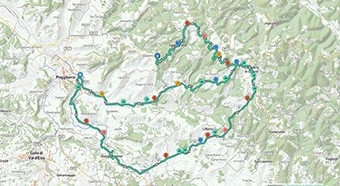

<iframe src="https://plugin.routeyou.com/poiviewer/free/?language=en&params.poi.id=8868782" width="100%" height="600" frameborder="0" allowfullscreen></iframe>

More than 11,800,000 routes

More than 15,000,000 users

More than 4,500,000 points of interest

Kerkstraat 108
9050 Gentbrugge, Belgium
© 2006-2026 RouteYou - www.routeyou.com



 | | Public |