Source: Pascal Brackman


Below the sediments in this area, you will find the Granodiorite of Naxos (pink on the map). Granodiorite is a plutonic igneous rock, formed by intrusion of silica-rich magma, which cools in batholiths or stocks below the Earth's surface. It is usually only exposed at the surface after uplift and erosion have occurred. A granodiorite intrusive igneous rock similar to granite, but containing more plagioclase feldspar than orthoclase feldspar. Biotite and amphiboles often in the form of hornblende are more abundant in granodiorite than in granite, giving it a more distinct two-toned or overall darker appearance. Mica may be present in well-formed hexagonal crystals, and hornblende may appear as needle-like crystals.
The Granodiorite has a very sharp contact with the gneisses and is full of large mafic enclaves, which are not xenoliths but fragments of early differentiated magma. The granodiorite is very coarse-grained, indicative of slow cooling because it was intruded into hot rocks (the gneisses). It represents the roots of a volcano, ie the magma chamber.
Source: Wikipedia & Doug Robinson
 | | Public | Dutch
Address: Greece
Statistics
Select one of the most popular activities below or refine your search.
Discover the most beautiful and popular trails in the area, carefully bundled into appropriate selections.
Source: Pascal Brackman
Select one of the most popular categories below or be inspired by our selections.
Discover the most beautiful and popular attractions in the area, carefully bundled in appropriate selections.
Source: Pascal Brackman
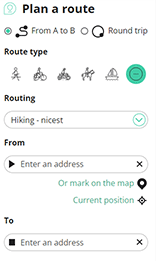
With RouteYou, it's easy to create your own customised maps. Simply plot your route, add waypoints or nodes, add places of interest and places to eat and drink, and then easily share it with your family and friends.
Route planner
<iframe src="https://plugin.routeyou.com/poiviewer/free/?language=en&params.poi.id=3144609" width="100%" height="600" frameborder="0" allowfullscreen></iframe>

More than 10,100,000 routes

More than 15,000,000 users

More than 4,500,000 points of interest

Kerkstraat 108
9050 Gentbrugge, Belgium
© 2006-2026 RouteYou - www.routeyou.com