Source: Utrechts Landschap


The Garster or Garsten mill drained the 306-hectare Garsten polder until 1960. Just like at the Hoekermolen, 1.8 km to the south, the water was lifted from the polder to the Vecht with a screw pump. Next to the mill, an electric pumping station was built in 1951 so that the drainage was no longer dependent on the wind. A mill that drains the land is called a polder mill. Along the way, you have already seen grain mills and an industrial mill. This is a classification by function. Mills can also be classified by type. The oldest form is the post mill, from which the flint mill developed ('t Haantje). In these mills, the entire wooden superstructure rotates with the sails and all. In a tower mill, only the cap with the wind shaft can rotate. The Vecht region has five post mills, which have a circular staging from which the sails can be turned into the wind. Finally, we see ground sailers, where the sails almost touch the ground (Hoekermolen).
 | | Public | Danish • Dutch • French • German • Italian • Spanish

Select one of the most popular activities below or refine your search.
Discover the most beautiful and popular trails in the area, carefully bundled into appropriate selections.
Source: Utrechts Landschap
Select one of the most popular categories below or be inspired by our selections.
Discover the most beautiful and popular attractions in the area, carefully bundled in appropriate selections.
Source: Utrechts Landschap
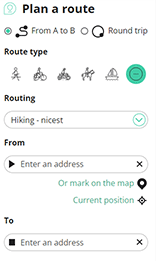
With RouteYou, it's easy to create your own customised maps. Simply plot your route, add waypoints or nodes, add places of interest and places to eat and drink, and then easily share it with your family and friends.
Route planner
<iframe src="https://plugin.routeyou.com/poiviewer/free/?language=en&params.poi.id=874082" width="100%" height="600" frameborder="0" allowfullscreen></iframe>

More than 11,800,000 routes

More than 15,000,000 users

More than 4,500,000 points of interest

Kerkstraat 108
9050 Gentbrugge, Belgium
© 2006-2026 RouteYou - www.routeyou.com