Source: Groenehartstocht
Oudewater a town since 1265
Bishop Henry of Vianden granted Oudewater town rights in 1265. The new city council immediately had its own seal made, which could be used to seal the decisions of the city council. It featured a violet in a diamond shape. The four-leaf symbolizes the original four city quarters: Gommiger, Wijdstrater, Leeuweringer, and Kapelle-Vierendeel, representing the community.
This seal was used for only a short time. In 1281, the bishop of Utrecht granted Oudewater along with several other villages to Count Floris V of Holland, who had lent him a lot of money. From that moment on, Oudewater belonged to Holland. Count Floris V gave Oudewater a new seal a few years later with the image that can still be seen in the city's coat of arms.
On July 19, 1572, Oudewater participated in the First Free States Assembly in Dordrecht, along with eleven other cities. This meeting laid the foundation for the Republic of the Netherlands under the 'leadership' of the House of Orange. In response, the city was exterminated on August 7, 1575, by a Spanish army; according to tradition, only three residents survived this massacre, known as "the Oudewater Murder."
Oudewater was an important producer of rope in the sixteenth and seventeenth centuries. The region provided the raw material hemp for this purpose. The residents of the town are still called Geelbuiken (Yellow Bellies) because the rope makers wrapped yellowish dried hemp fibers around their bellies. Oudewater still has a rope factory and a rope museum. The rope factory, G. van der Lee, is even the oldest existing family business in the Netherlands, dating back to 1545.
Source: Wikipedia
 | | Public | Danish • Dutch • French • German • Italian • Spanish

Select one of the most popular activities below or refine your search.
Discover the most beautiful and popular trails in the area, carefully bundled into appropriate selections.
Source: Groenehartstocht
Select one of the most popular categories below or be inspired by our selections.
Discover the most beautiful and popular attractions in the area, carefully bundled in appropriate selections.
Source: Groenehartstocht
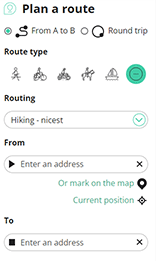
With RouteYou, it's easy to create your own customised maps. Simply plot your route, add waypoints or nodes, add places of interest and places to eat and drink, and then easily share it with your family and friends.
Route planner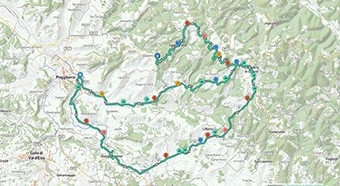
<iframe src="https://plugin.routeyou.com/poiviewer/free/?language=en&params.poi.id=8239175" width="100%" height="600" frameborder="0" allowfullscreen></iframe>

More than 11,800,000 routes

More than 15,000,000 users

More than 4,500,000 points of interest

Kerkstraat 108
9050 Gentbrugge, Belgium
© 2006-2026 RouteYou - www.routeyou.com