On November 12, 1878, the N.V. Rotterdamsche Tramweg Maatschappij was founded with the aim of operating a network of horse-drawn tramways in Rotterdam. It was the seventh tramway company in our country, but it would soon become one of the largest. Between 1878 and 1881, it was only the horse-drawn trams that demanded the attention of the young company. In 1881 the first steam tram line of the RTM was opened, the Rotterdam-Schiedam line, a standard gauge steam tram line that still exists today as one of the interurban lines of the RET. In 1898 the first interurban steam tramway to the islands was opened, the line from Rotterdam Rosestraat to the Hoekse Waard, but now built with narrow gauge (1067 mm instead of 1435 mm standard gauge). In between, the RTM also functioned as a kind of employment agency for small horse-drawn tramway companies, which could not cope on their own. For example, in Schiedam, Leiden, Sloterdijk, Hillegersberg and Dordrecht, the tram companies were helped with coachmen, carriages and sometimes conductors for a contractually stipulated amount.
The islands
At the end of the 19th century, Rotterdam grew like the proverbial cabbage; Rotterdam-Zuid in particular was the site where the new ports were built for transport to the new German Empire and especially the Ruhr area. The population increased dramatically. It was mainly people from the rural areas of West Brabant and the South Holland Islands who had to be counted among the "new Rotterdammers". These people maintained their family and social relations with the departure areas and so slowly but surely a flow of transport in that direction was created. Moreover, since 1870, the Hoekse Waard has been accessible by the famous Barendrecht Bridge. However, the road construction was largely too slow or was not carried out at all. A network of clay and, in more favourable cases, gravel roads caused stagnating transport, especially in wet times. If the islands wanted to benefit from Rotterdam as a growing market, there had to be an acceptable form of mass transport. At the turn of the century, this could only be the steam tram. The same committee that realized the construction of the Barendrechtse Brug worked for the construction of a steam tram line to Rotterdam. On Schouwen Duiveland, it was also a citizens' committee that made plans for a steam tram line between Brouwershaven and Steenbergen (with extension to Roosendaal). Both committees eventually came into contact with the RTM, which would be responsible for the construction and operation: in 1898 the Rotterdam-Zuid Beijerland line was opened, in 1900 the Brouwershaven-Steenbergen line. In the period 1903 to 1909 the line network was expanded or opened in the Hoekse Waard, Voorne Putten and Goeree Overflakkee. The line Brouwershaven - Burgh op Schouwen in 1915 was at the bottom of the list. By commissioning ferries and tugs, the steam tramways on the then still isolated islands were connected to the spider in the web, the metropolis of Rotterdam, on the understanding that the line between IJsselmonde (Middeldijk) and Zwijndrecht was oriented towards Dordrecht and the line between St.Philipsland (ferry port Anna Jacobapolder) and Steenbergen on West Brabant (Roosendaal and Breda).
 Azure
Azure | | Public | Danish • Dutch • French • German • Italian • Spanish
Address: Ouddorp
Statistics
Select one of the most popular activities below or refine your search.
Discover the most beautiful and popular trails in the area, carefully bundled into appropriate selections.
Select one of the most popular categories below or be inspired by our selections.
Discover the most beautiful and popular attractions in the area, carefully bundled in appropriate selections.
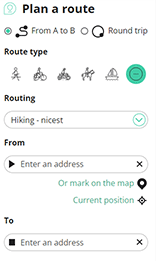
With RouteYou, it's easy to create your own customised maps. Simply plot your route, add waypoints or nodes, add places of interest and places to eat and drink, and then easily share it with your family and friends.
Route planner
<iframe src="https://plugin.routeyou.com/poiviewer/free/?language=en&params.poi.id=1766368" width="100%" height="600" frameborder="0" allowfullscreen></iframe>

More than 10,100,000 routes

More than 15,000,000 users

More than 4,500,000 points of interest

Kerkstraat 108
9050 Gentbrugge, Belgium
© 2006-2026 RouteYou - www.routeyou.com