Source: Groenehartstocht
A willow bed is a piece of land that is not well suited for arable farming, livestock farming, or horticulture, but can be used for planting willow branches or "toes".
Until the 1950s, primarily the outer dike banks of rivers were used as willow beds. This occurred, for example, in the Biesbosch, the Bommelerwaard, or the Gelderse IJssel region, but also on the banks of the Lek and the Hollandse IJssel.
In our region, willow toes were the basic material for making baskets and hoops. Especially in IJsselstein, basket and hoop making factories formed an important industry for a long time.
The owner of the willow bed planted the willow toes; depending on the quality or demand, toes were cut every year (cut willow) or every two to four years (harvested willow). Harvesting the willow toes, the willow culture, was heavy work; many men earned their living from it, especially in Jaarsveld. The toes were cut and then bound in bundles and soaked in water for some time to make them pliable. After that, the toes were "peeled," stripped of their bark; once that was done, the toe could be processed. The harvested willows provided material for broom and rake handles, roofing, and furniture, while the output from the cut willows was primarily used for making baskets and hoops. Not only men, but also women and children were engaged in peeling the toes and preparing the wood for further processing.
The working conditions for willow workers and toe peelers were not very good: they earned less than other workers, had to perform unhealthy and heavy work, and often sought comfort in excessive drinking. Only the establishment of their own trade union, the IJsselstein Toe Renters Association, brought some improvement in wages and living conditions.
Hoop-making factories existed in IJsselstein as early as the nineteenth century. The hoops were mainly used in making small barrels and baskets. Around 1860, there were about ten hoop-making factories; each employed about eight to twelve people. Most hoop-making factories in IJsselstein were combined with toe peeling and were spread throughout the city center. However, starting around 1900, this business began to decline due to the introduction of other packaging materials. The last hoop factory closed its doors in 1961.
In the wider area of IJsselstein, there was great demand for baskets in the past. In the Lopikerwaard, there were many fruit cultivation companies and cherry orchards that needed them for packaging and transporting their products. Willow toes were also used for weaving baskets. In IJsselstein, starting around 1900, when hoop making was on the decline, several basket factories emerged, of which the company W. Vink and Sons on Weidstraat became the largest. This company worked not only for individuals but also had the Dutch army among its clients. Besides making baskets, the company also dealt in fruit and the manufacture of reed furniture. The company continued to exist well into the last century.
The gradual disappearance of willow culture and its derived industries led to a decrease in employment, which, however, was largely compensated by the rise of furniture factories in IJsselstein. There were not many "new" willow workers and hoop makers anymore: young people opted for a less heavy and impoverished existence.
Source: RHC Rijnstreek
 | | Public | Danish • Dutch • French • German • Italian • Spanish

Select one of the most popular activities below or refine your search.
Discover the most beautiful and popular trails in the area, carefully bundled into appropriate selections.
Source: Groenehartstocht
Select one of the most popular categories below or be inspired by our selections.
Discover the most beautiful and popular attractions in the area, carefully bundled in appropriate selections.
Source: Groenehartstocht
With RouteYou, it's easy to create your own customised maps. Simply plot your route, add waypoints or nodes, add places of interest and places to eat and drink, and then easily share it with your family and friends.
Route planner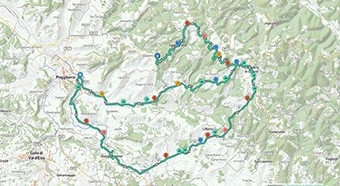
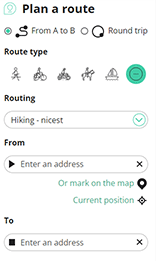
<iframe src="https://plugin.routeyou.com/poiviewer/free/?language=en&params.poi.id=8239104" width="100%" height="600" frameborder="0" allowfullscreen></iframe>

More than 10,100,000 routes

More than 15,000,000 users

More than 4,500,000 points of interest

Kerkstraat 108
9050 Gentbrugge, Belgium
© 2006-2026 RouteYou - www.routeyou.com