Source: GroeneHartstocht
Eduard Henricus Gerardus Hubertus Cuypers (Roermond, April 18, 1859 - The Hague, June 1, 1927) was a Dutch architect.
He was the son of decorator Henricus Hubertus Cuypers and Joanna Maria Elisabeth Hoff. Cuypers was educated at the architectural firm of his uncle Pierre Cuypers. In 1881, Eduard Cuypers established his own architectural office in Amsterdam. Thanks to good contacts with the business community, he received commissions for offices, retail buildings, villas, and residential homes. Despite his training, he did not work in the neo-Gothic style embraced by his uncle, but his work is strongly related to the neo-Renaissance and eclecticism. Unlike his uncle and his son Joseph Cuypers, Eduard Cuypers did not explicitly profile himself as a church builder, though he did construct a small number of churches. A more significant part of his oeuvre comprises the dozens of station buildings he designed, mainly constructed in the northern part of the country. For the construction of the railway line of the NOLS, he designed the station and stop buildings. His most monumental work was the second station of 's-Hertogenbosch, which he delivered in 1896. The building received much criticism in the trade press, including from the influential Berlage. This building was demolished after it was severely damaged during World War II. In addition to station buildings, he focused on private homes, hotels, and restaurants.
In 1899, Cuypers moved to a house he designed on Jan Luijkenstraat. He lived on the ground floor. The first and second floors were intended as a young men's residence, meant for resident staff. He also maintained a library where he collected books on architecture, art, and culture. In the attic, there was a studio where female staff worked on lampshades, curtains, and upholstery. There were also spaces set up as exhibition areas where visitors could be informed about developments in interior design.
By 1905, Cuypers' architectural office and studio employed around fifty people, making it one of the largest in the Netherlands. For the design of the Peace Palace, Cuypers submitted no less than four entries, but none of the submissions were selected.
Cuypers and his staff also designed many art and craft products, such as furniture, lamps, and glass tableware. Cuypers' interest in interior art led to the publication of the magazine "Het Huis" (The House) in 1903 and from 1905 to Het Huis, Oud & Nieuw (The House, Old & New): a monthly illustrated book dedicated to interior furnishing, construction, and decorative arts, which was published until 1927.
Building in Dutch East Indies
The building of the Javasche Bank in Yogyakarta, Indonesia from 1915, by Eduard Cuypers.
Cuypers came into contact with the Dutch East Indies when he received a commission from the director of De Javasche Bank, Gerard Vissering, in 1907 to design several bank buildings. They had gotten to know each other when Cuypers was commissioned to expand the branch of the Amsterdam Bank, of which Vissering was then the director. The new bank buildings in the Indies needed to exude prestige, comparable to the bank and government buildings in cities like Singapore, Hong Kong, Sydney, and Manila. An influential architect in the Indies, Moojen, was first given the opportunity to design the bank buildings. However, his designs in a contemporary Dutch architectural style and in the spirit of Berlage were not well received. Vissering knew that Cuypers had an affinity for the Beaux-Arts style, a style he deemed suitable for the Indies. This architectural style was not popular in the Netherlands and thus was hardly used.
At Vissering’s suggestion, Cuypers formed a partnership with the experienced architect-contractor in the Dutch East Indies, Marius Hulswit. That same year, construction began on two bank buildings designed by Cuypers, one in Medan and the other in Soerakarta. In 1909, Cuypers traveled to the Indies to explore sites for future banks, to see the progress, and to sign the agreement with Hulswit. Together with Hulswit, Cuypers started an Indo architectural firm ‘Ed. Cuypers en Hulswit’ which was established in Weltevreden. For the World Exhibition of 1910 in Brussels, he was allowed to design the presentation of Indonesian products as well as the Dutch garden. Cuypers returned to the Netherlands after his trip, from where he created and sent designs for Indonesian projects. The firm faced much resistance from the municipality in Batavia, where the aforementioned Moojen wielded significant influence over the evaluations of building plans, and it was forced to build in the Dutch-Indonesian architectural style. In 1914, Hulswit and Cuypers also associated with A.A. Fermont's technical office, which was concerned with the execution of projects, and the name was changed to ‘Hulswit, Fermont en Ed. Cuypers’. In 1921, it became ‘N.V. Architecten-Ingenieursbureau Hulswit en Fermont te Weltevreden en Ed. Cuypers te Amsterdam’. After the death of Eduard Cuypers, the firm was named Fermont-Cuypers, which existed until the nationalization in 1958.
Cuypers and Hulswit’s architectural firm played a significant role in the development of Indo architecture in the first half of the twentieth century. Due to the style and the use of the latest techniques, the firm was popular with the business community. His designs were in classical Renaissance and Baroque style with indigenous influences. The firm built, among other things, the headquarters of De Javasche Bank in Batavia, twelve branches of that bank, including a branch in Yogyakarta, the building of the Hongkong Shanghai Bank, and offices for the Chartered Bank, the Nederlandsche Handel-Maatschappij, and the Escompto Bank. Additionally, it built office buildings for trading houses such as the WEVA building, the Handelsvereeniging Amsterdam, Lindeteves-Stokvis, and a building for the International Credit and Trade Association Rotterdam, the office of the Borneo Company, and insurance companies such as Dordrecht, and a factory for the British American Tobacco Company. It also built a clubhouse for the cricket club, a pharmacy, a bookstore, a clinic, a hospital, schools, Catholic churches, and a hotel. It was the most productive firm of all private firms in the Dutch East Indies.
Cuypers was impressed by the beauty of the Indonesian landscape and had an interest in Indonesian folk art. This inspired him to establish a magazine. In the first magazine Het Ned.-Indische Huis oud & nieuw that was published biannually for three years between 1913 and 1915, it discussed architecture and decorative arts and had many articles about the buildings of his firm Cuypers-Hulswit. In 1916, he established a new magazine: Nederlands-Indië Oud & Nieuw (NION) which had a more general nature and addressed topics about the Indies. This magazine was published until 1934.
Work in the Netherlands
In the Netherlands, the architectural firm, which aligned with international Baroque and classicism, increasingly engaged in utilitarian projects such as schools, Catholic institutions, and hospitals. The firm never received a commission for social housing, where rational designs were the creed.
Cuypers' firm is seen as the origin of the Amsterdam School because the leaders of this style, Michel de Klerk, Joan van der Mey, and Piet Kramer, were all trained in his office. Berend Tobia Boeyinga, one of the key followers of the Amsterdam School, also worked for Cuypers for some time. Besides the architects associated with the Amsterdam School, Charles Estourgie also started his career at Cuypers' office. Cuypers designed his own house and office in 1898. The firm was located in the building he designed himself at Jan Luijkenstraat 2 in Amsterdam next to the Rijksmuseum, designed by his uncle Pierre Cuypers.
According to his obituary, he was a knight in the Order of Orange-Nassau, the Order of Leopold, and the Order of the Crown of Belgium. Furthermore, he was said to possess the Cross of Merit from the Netherlands Red Cross and that of the Sovereign Order of Malta.
The family of Cuypers announced a limited design competition for a gravestone under the motto Requiem Aeternam after his death, allowing only employees of the office to submit entries. The winner, after evaluating eleven submissions and models, was architect Willem Hermanus Josef Desain/De Sain (Amsterdam, April 7, 1893 - there May 18, 1953), who later became an architect at the Rijksgebouwendienst. The final monument looked somewhat different from the design. The gravestone is also visible from outside the cemetery.
Source: Wikipedia
 | | Public | Danish • Dutch • French • German • Italian • Spanish

Select one of the most popular activities below or refine your search.
Discover the most beautiful and popular trails in the area, carefully bundled into appropriate selections.
Source: GroeneHartstocht
Select one of the most popular categories below or be inspired by our selections.
Discover the most beautiful and popular attractions in the area, carefully bundled in appropriate selections.
Source: GroeneHartstocht
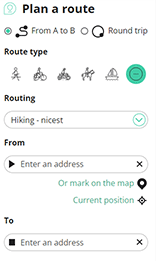
With RouteYou, it's easy to create your own customised maps. Simply plot your route, add waypoints or nodes, add places of interest and places to eat and drink, and then easily share it with your family and friends.
Route planner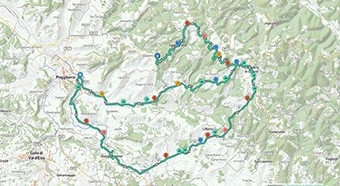
<iframe src="https://plugin.routeyou.com/poiviewer/free/?language=en&params.poi.id=8271290" width="100%" height="600" frameborder="0" allowfullscreen></iframe>

More than 11,800,000 routes

More than 15,000,000 users

More than 4,500,000 points of interest

Kerkstraat 108
9050 Gentbrugge, Belgium
© 2006-2026 RouteYou - www.routeyou.com