Source: Rieno ✅ Routes


The first mention dates back to 1339 when a certain Arnold van Zijl calls himself "van Lunenburg".
The status of the van Zijl family declined in the 15th century. In 1402 the tower was given to Gijsbrecht van Lockhorst as a fief by the provost of the cathedral:
"Item Ghijsbrecht van Lochorst hout van den domproest een toerne te Lunenborch met enen merghen lants daer die toern opstaet inder wegen als die brieve houdenen die daer op sijn"
Twenty years later, in 1422, Gijsbrecht de Ridder was granted the property. However, a descendant of his, Willem de Ridder, had to sell the tower due to debts.
In 1772 Lunenburg was described in the Present State as:
"consisting likewise of a heavy Tooren, with two windirons. There is also a skilful gentleman's house, from which one goes, with a wooden bridge, to the old Tooren, which is surrounded by a large grave."
After changing hands several times, the property came into the hands of the Van Lynden family. Around the end of the 18th century, the Van Lynden family had the moat filled in, the buildings of the forecourt demolished and the tower expanded into a plastered classicist country house.
During the Second World War, the house, which had never withstood a siege, was badly damaged by an Allied bombing raid in September 1944; probably because German army vehicles were parked under the trees. Part of the 19th-century extension was affected and a heavy crack appeared in the tower.
Shortly after the war, a number of restoration plans were made, all based on partial or complete restoration of the classicist house. Due to a lack of financial resources, these plans did not make it. When the owner E.R. van Eibergen Santhagens died in 1958, the mansion was uninhabitable. He bequeathed the estate to his secretary. With the application for a demolition permit, the end of the castle seemed near.
In 1968 the tower came into the hands of the K.F. Hein Foundation, which provided funds for repairs.
During the restoration in 1968-'70, under the direction of architect E.A. Canneman, the tower was restored to its medieval appearance. On the basis of 18th-century drawings and prints, the moat and the wooden bridge leading from the outer bailey to the main floor of the tower were also reconstructed. The 17th-century house with stable on the outer bailey was also reconstructed. The bridge, which dates from 1865, the monumental entrance gate and the plastered coach house were retained.
Source: wikipedia
 Azure
Azure | | Public | Danish • Dutch • French • German • Italian • Spanish
Address: Langbroek, gemeente wijk bij Duurstede
Statistics
Select one of the most popular activities below or refine your search.
Discover the most beautiful and popular trails in the area, carefully bundled into appropriate selections.
Source: Rieno ✅ Routes
Select one of the most popular categories below or be inspired by our selections.
Discover the most beautiful and popular attractions in the area, carefully bundled in appropriate selections.
Source: Rieno ✅ Routes
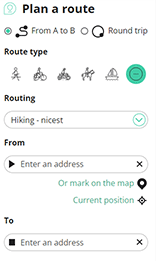
With RouteYou, it's easy to create your own customised maps. Simply plot your route, add waypoints or nodes, add places of interest and places to eat and drink, and then easily share it with your family and friends.
Route planner
<iframe src="https://plugin.routeyou.com/poiviewer/free/?language=en&params.poi.id=7452637" width="100%" height="600" frameborder="0" allowfullscreen></iframe>

More than 11,800,000 routes

More than 15,000,000 users

More than 4,500,000 points of interest

Kerkstraat 108
9050 Gentbrugge, Belgium
© 2006-2026 RouteYou - www.routeyou.com