Source: Rieno ✅ Routes
Most of the water in the Langbroekerwetering is rainwater, coming from the Utrecht Hill Ridge. Via ditches and brooks, the water flows into the Langbroekerwetering. A portion flows underground and rises to the surface north of this drainage canal. This spring water, filtered through deep sandy layers, is very clean, low in nutrients, and extremely suitable for plants and animals. When rain is long overdue, the ditches north of the Gooyerwetering dry up. For the area south of the Gooyerwetering, water from the Kromme Rijn can be let in through the Melkwegwetering at Wijk bij Duurstede and the Cothergrift. During heavy rainfall, the opposite happens. Excess water is then drained away via this route to the Kromme Rijn.
Due to the enormous population increase between the 11th and 13th centuries, large-scale reclamation projects were initiated around Langbroek. The authorities of Sticht Utrecht also recognized the necessity and benefits of this. One of the areas to be cultivated was Langbroek. Langbroek, at the foot of the Utrecht hill ridge, was a marshy area on the silted river clay of the Rhine. There were two problems in reclaiming this area. The swamp had no drainage, and the area was repeatedly filled by the annual flooding of the Rhine. Therefore, the Kromme Rijn was closed off in 1122. Once the water flows were redirected, drainage of Langbroek could begin. For this purpose, a ditch was dug in phases between Overlangbroek and Odijk. The Langbroekerwetering divides the land in two. Crosswise, the plot ditches were dug. Parallel to the Cotherweg, elongated plots were laid out on both sides of the Langbroekerwetering, which were wide enough for a farm. The plots were often bordered by pollarded trees or hedgerows.
After 1122, the bishop of Utrecht sold the parcels (copes). The purchasers of this land (copers) were obliged in the agreement to pay 'tithes'. Furthermore, the bishop retained jurisdiction within this area. He believed he could do this based on his general claim to the uncultivated land. The Utrecht Chapter did not share the bishop's opinion. The reason was that there were already older rights on surrounding domains with Doorn as the pivot, where the parish had obtained the right to usufruct as early as the 9th century. Once the land was reclaimed, the areas would therefore fall under the Chapter. In 1126, Bishop Godebold admitted his mistake and the contracts lapsed to the Chapter. The dean took over the leadership of the reclamation after 1126.
The new area was in demand. Along the ditch, several noble houses and residential towers were built. The construction of fortifications was encouraged by the rulers of Sticht. It was likely felt that with the filling in of the swamp on the eastern side of their area, a natural defensive wall had been lost. People with means were allowed to build a fortification (residential tower) and were knighted.
Characteristic of this area are small landscape elements such as scrub (bush growth), thickets, coppice complexes, ponds, and of course orchards with high-stemmed fruit trees.
 | | Public | Danish • Dutch • French • German • Italian • Spanish

Select one of the most popular activities below or refine your search.
Discover the most beautiful and popular trails in the area, carefully bundled into appropriate selections.
Source: Rieno ✅ Routes
Select one of the most popular categories below or be inspired by our selections.
Discover the most beautiful and popular attractions in the area, carefully bundled in appropriate selections.
Source: Rieno ✅ Routes
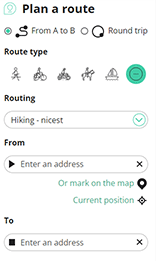
With RouteYou, it's easy to create your own customised maps. Simply plot your route, add waypoints or nodes, add places of interest and places to eat and drink, and then easily share it with your family and friends.
Route planner
<iframe src="https://plugin.routeyou.com/poiviewer/free/?language=en&params.poi.id=7471319" width="100%" height="600" frameborder="0" allowfullscreen></iframe>

More than 10,100,000 routes

More than 15,000,000 users

More than 4,500,000 points of interest

Kerkstraat 108
9050 Gentbrugge, Belgium
© 2006-2026 RouteYou - www.routeyou.com