Source: Groenehartstocht
What the Kippenkade owes its name to is not known, or it should be because it is so narrow that you can only walk there like chickens one after the other.
What is certain is that it is actually not a quay, but an old embankment of a natural peat stream.
Along the winding Kippenkade we follow an old winding peat stream that ended in the Oude Bodegravestroom, which flows into the Rhine a little further on. Possibly this water once bore the short Batavian name Wi or Wije because many regional names are derived from it. Written sources are lacking, but names such as Weijpoort (Wi-portes) and Wiltenburg (Wi-burch) and even Wiericke (Wierinxsloot) may have originated here.
On the other side of the Rhine, the same thing happened to Mi and Mije. Wi, in turn, may refer to the Germanic word "wirim", which denoted a place in the swamp. Eventually, this peat stream formed the first access to the Reeuwijkse Land by water from the Rhine. In its course, the winding Oukoopsedijk follows this former meandering peat river upstream to its source in the middle of the polder.
It was these drainage streams of the high peatlands that formed the access to this area in the 10th century. After all, the only way to penetrate the wasteland was by water. The Kippenkade has withstood the mining in the 11th century, the dyeing in the 17th century and even the urbanization in this time and is still there in its original form after all this time.
The path was also used as a possible smuggling route in the border area between Utrecht and Holland. In Holland, flour, bread, salt and soap were taxed much more heavily than in Utrecht. Especially for smuggling, illegal ditches and surreptitious roads were built through the swamp.
Because of this lucrative trade, bakers and millers settled in the border area in secret houses. For example, in the Lange Weide in Driebruggen lived a beer distiller (wholesaler in drinks) and a bread baker with 3 servants. They couldn't eat and drink that much in Driebruggen. The smuggling of a loaf of bread was subject to a large fine. To combat smuggling, country houses were erected and manned with 'cherges' (customs officers)
Source: strolling and researching
 Azure
Azure | | Public | Danish • Dutch • French • German • Italian • Spanish

Select one of the most popular activities below or refine your search.
Discover the most beautiful and popular trails in the area, carefully bundled into appropriate selections.
Source: Groenehartstocht
Select one of the most popular categories below or be inspired by our selections.
Discover the most beautiful and popular attractions in the area, carefully bundled in appropriate selections.
Source: Groenehartstocht
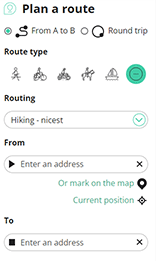
With RouteYou, it's easy to create your own customised maps. Simply plot your route, add waypoints or nodes, add places of interest and places to eat and drink, and then easily share it with your family and friends.
Route planner
<iframe src="https://plugin.routeyou.com/poiviewer/free/?language=en&params.poi.id=7577060" width="100%" height="600" frameborder="0" allowfullscreen></iframe>

More than 11,800,000 routes

More than 15,000,000 users

More than 4,500,000 points of interest

Kerkstraat 108
9050 Gentbrugge, Belgium
© 2006-2026 RouteYou - www.routeyou.com