Guayama , officially the Autonomous Municipality of Guayama is a city and municipality on the Caribbean coast of Puerto Rico. As of the 2010 U.S. Census, the city had a population of 45,362. It is the center of the Guayama metropolitan area, which was home to 84,214 in 2010.
During the early years of the Spanish colonization, the region known today as Guayama was inhabited by Taíno Native People. The indigenous population in this area decreased due to slavery and migration to the Lesser Antilles. The following centuries, the region was under attack from the Taíno rebellion, Caribs and pirates. The town was founded on January 29, 1736 as San Antonio de Padua de Guayama by then Spanish Governor Matías de Abadía, although there is knowledge of it being populated by native people as early as 1567. Guayama took its name from an Indian leader, or cacique who governed the Southeastern region of the Island, the Guamaní cacique and the Guayama cacique. The meaning of the Indian name is "Great Place" . It was Governor Don Tomás de Abadía who officially declared Guayama a "pueblo" with the name of San Antonio de Padua de Guayama. That same year the Catholic Church in town, San Antonio de Padua, was declared a Parish. In 1776, Guayama had 200 houses, the church and a central plaza and the total population was approximately 5,000 villagers. Construction on Guayama's Parroquial church of San Antonio de Padua began in 1827 and was completed 40 years later. In 1828 the construction of the King's House was completed and the church was rebuilt as well. Earlier that year, Guayama was hit by a terrible fire that destroyed 57 houses and 9 huts. Guayama territorial order was altered at different times through the years. Some of the most populated neighborhoods were segregated to form new towns. Patillas was established in 1811 as an independent municipality. In 1831, the territory comprised the neighborhoods: Algarrobos, Ancones, Arroyo, Carreras, Guayama Pueblo, Guamaní, Jobos, Machete, and Yaurel. Later, Arroyo was divided into Arroyo Este and Arroyo Oeste and neighborhoods emerged: Pozo Hondo, Palmas de Aguamanil, Caimital, Pitajayas, Cuatro Calles, Sabana Eneas, Palmas, and Salinas. The latter had been segregated from Coamo.
Source: Wikipedia.org
Copyright: Creative Commons 3.0

Select one of the most popular activities below or refine your search.
Discover the most beautiful and popular trails in the area, carefully bundled into appropriate selections.
Source: Guaraguao
Copyright: Creative Commons CC BY 2.0
Select one of the most popular categories below or be inspired by our selections.
Discover the most beautiful and popular attractions in the area, carefully bundled in appropriate selections.
Source: Guaraguao
Copyright: Creative Commons CC BY 2.0
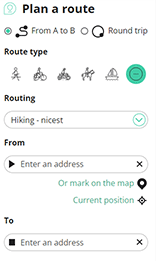
With RouteYou, it's easy to create your own customised maps. Simply plot your route, add waypoints or nodes, add places of interest and places to eat and drink, and then easily share it with your family and friends.
Route planner
<iframe src="https://plugin.routeyou.com/poiviewer/free/?language=en&params.poi.id=7684784" width="100%" height="600" frameborder="0" allowfullscreen></iframe>

More than 11,800,000 routes

More than 15,000,000 users

More than 4,500,000 points of interest

Kerkstraat 108
9050 Gentbrugge, Belgium
© 2006-2026 RouteYou - www.routeyou.com



 | | Public |