Regarding the antiquity of the castle of Lamego, almost all the authors consulted say that the castle "was the work of the Moors" and that it dates back to before the foundation of the nationality.
Of the original castle , only the keep (12th century), part of the old wall and the cistern (13th century) remain.
The keep, about twenty metres high, is quadrangular and has light openings on the sides, some of which were transformed into windows in the 16th century, by order of the last Count of Marialva, D. Francisco Coutinho, perhaps with the aim of giving the tower a residential function. It has a square of arms in the shape of an irregular hexagon, whose wall, with a perimeter of about 90 metres, has an adarve that is accessed from the north side by a staircase.
Between 1939 and 1940 , when the centenary of the foundation and restoration of the Portuguese nation was celebrated, the castle was restored , removing the bells and chimes at the top of the tower to add battlements.
Access to the old castle town is through two open porticos in the wall. Those entering from the north go through the arch called "Porta dos Figos or dos Fogos" , also known as "Porta da Vila or do Aguião" , while the door on the other side is called "Porta do Sol" . Next to the latter is an interesting house with emblems that belonged to the Cistercian Order and later became the wheelhouse. On the north side, the Casa da Torre still stands, which now serves as the headquarters of the National Scout Corps. This building housed the town hall until 1834 , when it was moved to the Casa da Relação (now Paço do Bispo). In the middle of the Rua do Castelo we see the chapel of Senhora do Socorro , on the outside wall of which is an interesting tiled tableau with the inscription "NS do Coro 1671". S. do Coro 1671". Nearby there was another chapel invoking the Holy Savior, where the original cathedral is said to have stood.
The Lamego Cistern , located outside the Armorial Court, is rectangular and vaulted, with a ribbed ogive supported by wide bands resting on pillars. It is approximately twenty metres long and ten metres wide and is considered " one of the best examples of Portuguese castle cisterns " (Direção Geral dos Edifícios e Monumentos Nacionais cit. Laranjo, 1994, p.52). In November 2013, the Lamego Cistern was reopened and saw the light of day again, after a major renovation. Images, sounds, letters, experiences and traditions are now available to the public in a space that is now a Centre of Memory.
Entering the Cistern, visitors are immersed in the past, where multiple memories are continuously projected onto the stones that were once mere spectators. A sound system is connected to the space, evoking 800 years of everyday sounds: the bell, the rooster, the stonemason, the preaching, the procession, weeping and laughing.
Source: Willem Vandenameele
 | | Public | Catalan • Dutch • French • German • Italian • Spanish

Select one of the most popular activities below or refine your search.
Discover the most beautiful and popular trails in the area, carefully bundled into appropriate selections.
Source: Wikimedia
Select one of the most popular categories below or be inspired by our selections.
Discover the most beautiful and popular attractions in the area, carefully bundled in appropriate selections.
Source: Wikimedia
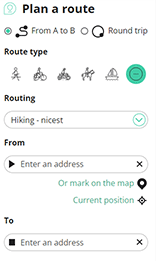
With RouteYou, it's easy to create your own customised maps. Simply plot your route, add waypoints or nodes, add places of interest and places to eat and drink, and then easily share it with your family and friends.
Route planner
<iframe src="https://plugin.routeyou.com/poiviewer/free/?language=en&params.poi.id=8993540" width="100%" height="600" frameborder="0" allowfullscreen></iframe>

More than 11,800,000 routes

More than 15,000,000 users

More than 4,500,000 points of interest

Kerkstraat 108
9050 Gentbrugge, Belgium
© 2006-2026 RouteYou - www.routeyou.com