Source: Willem, Vandenameele
The castle was built in the 10th century AD, in what was then one of the most important cities of the County of Portucale, predecessor of Portugal.
In 2007 it was declared one of the Seven Wonders of Portugal.
During the Reconquista of the Iberian Peninsula, the estate of Vimaranes was granted to a (probably Castilian) knight named Diogo Fernandes. One of his daughters, Mumadona Dias, married the influential Count Hermenegildo Gonçalves. The couple and their descendants ruled the domains of Portucale from the mid-tenth to three-quarters of the eleventh century. Around 950, Mumadona Dias was widowed and after her death the vast estates were divided among her six children. At the same time, Mumadona had a monastery built in the lower part of the village of Vimaranes, the old name for Guimarães.
The village of Vimaranes was originally divided into two nuclei : one on top of Monte Largo (literally "wide mountain") and the other at the foot of this mountain, where the monastery was also built. It was a vulnerable building at that time, due to the constant threat of Moorish attacks from the south (the Reconquista had not yet reached Coimbra) and Norman attacks from the north.
Because of this threat, the mistress began the construction of a castle on top of Monte Largo , where the people could flee in case of need. This castle was donated to the religious in December 958. It is believed that the castle was only a simple building, consisting of nothing more than a tower with a wall around it.
A little over a century later, the area in which the village was situated was donated by King Alfonso VI of León to Henry of Burgundy. These areas formed the County of Portucale. The count and his wife chose the castle in Vimaranes as their residence. The primitive building of Mumadona Dias was probably demolished for this reason, and an imposing keep was built in its place . The wall was enlarged and reinforced and was given two gates.
In 1127, King Alfonso I of Portugal resisted attacks from King Alfonso VII of León and Castile in this castle. The following year, King Alfonso I of Portugal won the battle of Teresa of León in the nearby field of São Mamede, after which Portuguese nationality was born.
Between the end of the twelfth century and the beginning of the thirteenth, King Sancho I moved to the upper part of the village and probably began to build the walls around the town. In the middle of the thirteenth century, during the reign of King Alfonso III, work began on the definitive wall, uniting the two parts of the village. This work was probably completed during the time of King Dionysius. It was not until around 1420 that the original wall of the upper part was demolished.
From the fifteenth century, the castle lost its defensive role due to advances in artillery. In several decrees, from 27 August 1908 and from 1910, the castle was classified as a national monument of Portugal. From 1937, the castle was renovated . Today it is in good condition and open to the public. Although the castle itself is not a World Heritage Site, it is part of the historic centre of Guimarães, which is considered a World Heritage Site by UNESCO.
Source: Willem Vandenameele - Wikipedia
 | | Public | Catalan • Danish • Dutch • French • German • Italian • Spanish

Select one of the most popular activities below or refine your search.
Discover the most beautiful and popular trails in the area, carefully bundled into appropriate selections.
Source: Willem, Vandenameele
Select one of the most popular categories below or be inspired by our selections.
Discover the most beautiful and popular attractions in the area, carefully bundled in appropriate selections.
Source: Willem, Vandenameele
With RouteYou, it's easy to create your own customised maps. Simply plot your route, add waypoints or nodes, add places of interest and places to eat and drink, and then easily share it with your family and friends.
Route planner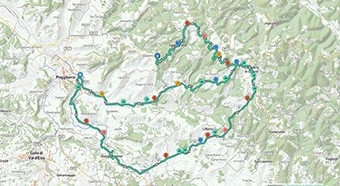
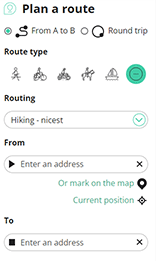
<iframe src="https://plugin.routeyou.com/poiviewer/free/?language=en&params.poi.id=9000747" width="100%" height="600" frameborder="0" allowfullscreen></iframe>

More than 11,800,000 routes

More than 15,000,000 users

More than 4,500,000 points of interest

Kerkstraat 108
9050 Gentbrugge, Belgium
© 2006-2026 RouteYou - www.routeyou.com