Source: Willem Vandenameele


The establishment of Ponte de Lima's Santa Casa da Misericórdia dates back to 1530.
The church was built in the 17th century. The choir dates from 1638, when it also had a stone roof with a coffered ceiling.
The current layout is the result of the opening of Rua Cardeal Saraiva at the end of the 1920s, which divided the former hospital building in two and moved the Baroque portico of the convent to the facade on this road.
The interior is characterized by a single nave, a choir with a vault (1638) and a main portico that opens onto the side of the cemetery , which forms the cemetery today enclosed by a curious fence, and the effect of the portico that delimits this enclosure is remarkable.
Great Baroque artists from the north of the country worked here, such as Manuel de Almeida, documented in 1699, the sculptor Manuel Dias, who worked on the side altarpieces, the sculptors Manuel and Miguel Coelho, and the important architect Manuel Dias da Silva. The best paintings were made by Manuel Cardoso do Vale and Manuel da Rocha in the last years of the 17th century.
The vault of the church is decorated with a baroque painting and has a false structure of gothic ribs, which are no more than decorative elements and have no load-bearing function. Another baroque element is the imposing high choir balustrade , which reaches far into the nave. Continuous renovations and improvements led to the replacement of altars that were also baroque by others of a neoclassical nature, which was more fashionable at the time.
Highlights inside include the ribbed vault in polychrome and gilded wood, the neoclassical main and side altars, the central panel in high relief from the original main altarpiece, the altar front with the scene of the miracle of the multiplication of the loaves and an interesting eighteenth-century painting. The sacristy with its large conference table in pink marble and Baroque decoration is also noteworthy.
The two figures flanking the main portico represent a beggar with an alms bag and a pilgrim.
Source: Willem Vandenameele - Wikipedia
 | | Public | Catalan • Danish • Dutch • French • German • Italian • Spanish

Select one of the most popular activities below or refine your search.
Discover the most beautiful and popular trails in the area, carefully bundled into appropriate selections.
Source: Willem Vandenameele
Select one of the most popular categories below or be inspired by our selections.
Discover the most beautiful and popular attractions in the area, carefully bundled in appropriate selections.
Source: Willem Vandenameele
With RouteYou, it's easy to create your own customised maps. Simply plot your route, add waypoints or nodes, add places of interest and places to eat and drink, and then easily share it with your family and friends.
Route planner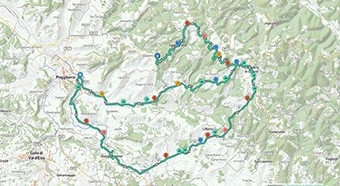
<iframe src="https://plugin.routeyou.com/poiviewer/free/?language=en&params.poi.id=9009316" width="100%" height="600" frameborder="0" allowfullscreen></iframe>

More than 11,800,000 routes

More than 15,000,000 users

More than 4,500,000 points of interest

Kerkstraat 108
9050 Gentbrugge, Belgium
© 2006-2026 RouteYou - www.routeyou.com