Source: Groenehartstocht
The origin of Estate Bredius dates back to 1824. In that year, Jacobus Bredius, notary and mayor of Woerden, purchased several plots of land just outside the city walls from brick manufacturers. At that time, clay was being extracted in the Old Rhine river basin for the roofing tile industry.
His son Cornelis brought the estate to prosperity: a mixed farm with livestock and fruit cultivation. He built the farmhouse Batestein (1852) and villa Rijnoord (1863), where he moved in. The winding forest was used as a recreational walking forest for the family. There was also a ‘pleasure wood’ east of the villa. As was customary, there was also a vegetable garden on the estate. The exact location of this is not known. It is plausible that the vegetable garden was located somewhere near the farmhouse.
More fruit cultivation
After Cornelis's death in 1873, the estate came into the hands of his sons Jacobus and Arnoldus. They managed it jointly but did not live on the estate. Daily management was carried out by farmer Izak Bos, and later his son Teunis Bos, both of whom lived in the farmhouse. A barn is also part of the farmhouse. Over time, it has been used as a summer house, a pigsty, and a cart shed. Additionally, there were several day laborers' houses, of which one has been preserved (on the 's-Gravensloot). Arnoldus significantly expanded fruit cultivation. More high-stem fruit trees with apples and pears and a berry garden were established. Raspberries, strawberries, and vegetables were also cultivated.
During the period 1906-1920, a son of Arnoldus, Cornelis J.A. Bredius, further expanded the estate. He purchased surrounding plots, after which fruit cultivation reached its peak. The last Bredius to live on the estate was Arnoldus Anthonie Bredius (1903-1982), an agricultural scientist and livestock farmer. He lived in the farmhouse from 1947 to 1966 and managed the estate.
Other destination
In the early fifties of the last century, Arnoldus Anthonie was confronted with plans from the municipality of Woerden for the construction of a road and housing on his territory. He and other citizens fiercely opposed this because they wanted to preserve the estate. Ultimately, the estate was partially expropriated by the municipality of Woerden between 1964 and 1970 and partially purchased. Citizens, united in the Bredius Core Group, subsequently successfully halted the municipality's plans.
Nevertheless, buildings have encroached on the edges of the estate, particularly with ‘t Oude Landt (care homes and senior residences). Homes in De Veste have also been built adjacent to the estate.
The latest ruling on the function of the estate came from the Council of State in 2011, limiting the expansion plans of 't Oude Landt to a maximum building height of 15 meters. Additionally, a maximum of four houses may be built on the northern edge of the estate.
Since 1970, the estate has been publicly accessible.
New start
By 2011, the estate had lost much of its former glory. To be a pleasant place for citizens and visitors and to maintain the valuable landscape, cultural-historical, and natural elements, restoration and better maintenance were needed.
In the autumn of 2011, the Bredius Core Group began a tour of organizations involved with the park. The aim was to map out whether improvements in the park could be realized through a joint approach. With support from the Royal Dutch Heath Society (KNHM) and Arcadis, this led to a citizens' initiative encompassing fourteen interested organizations and several concerned citizens: Stichting Kerngroep Bredius, Dierenweide Kukele-boe, Brediushonk, Stichting InBredius, IVN Woerden, KNNV Stichts-Hollandse Polderland, NME Woerden and Oudewater, Babylon, owner of farmhouse Batestein, Camping Batenstein, Reformed Community, Abrona, Stichting Groene Hart, Stichting Hugo Kotestein, a historical green advisor, a cultural technical advisor, and several concerned citizens.
Paradise in the city
Under the title ‘Paradise in the city’, a joint vision was formulated for the restoration and sustainable management of the estate. In 2013, this vision was developed into a concrete maintenance and development plan. At the end of 2013, the municipality approved and agreed to cooperate in its implementation.
On March 31, 2014, the Stichting Landgoed Bredius was established. This foundation took over the management of a large part of the estate from the municipality of Woerden as of January 1, 2015. The Foundation works closely with the involved organizations and many volunteers, who enthusiastically dedicate themselves to improving and preserving the estate for the future.
The Estate Bredius is actually called Estate Batestein, named after the farmhouse. The municipality has referred to it as Park Bredius since 1970. The name Estate Bredius brings back the special and valuable character of the area in the name.
Text source: Estate Bredius
 | | Public | Danish • Dutch • French • German • Italian • Spanish

Select one of the most popular activities below or refine your search.
Discover the most beautiful and popular trails in the area, carefully bundled into appropriate selections.
Source: Groenehartstocht
Select one of the most popular categories below or be inspired by our selections.
Discover the most beautiful and popular attractions in the area, carefully bundled in appropriate selections.
Source: Groenehartstocht
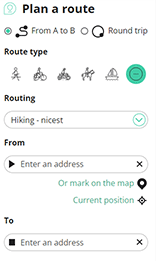
With RouteYou, it's easy to create your own customised maps. Simply plot your route, add waypoints or nodes, add places of interest and places to eat and drink, and then easily share it with your family and friends.
Route planner
<iframe src="https://plugin.routeyou.com/poiviewer/free/?language=en&params.poi.id=7577713" width="100%" height="600" frameborder="0" allowfullscreen></iframe>

More than 10,100,000 routes

More than 15,000,000 users

More than 4,500,000 points of interest

Kerkstraat 108
9050 Gentbrugge, Belgium
© 2006-2025 RouteYou - www.routeyou.com