Source: Kennes, Hilde, 10-05-2016, ©Vlaamse Gemeenschap
Copyright: All rights reserved


The castle De Toren or the little castle Doctor Roelants is a country house from the early 19th century that was expanded into a closed entity in 1847, to be reduced to an L-shape, its current composition, in 1873. The surrounding park was likely also laid out in 1873. History The estate De Toren, also known as the little castle of Doctor Roelants, named after the owner since 1907, was in the early 19th century owned by Baron de Heusch from Donk, who owned a property with buildings in a loose arrangement according to the Primitive cadastral plan. The documents prior to the cadastral valuation describe the main building as a rentier house made of brick and limestone, located along the highway and near the village, consisting of "three places, a small cabinet, a kitchen, and four rooms on the upper floor, with a beautiful rear place, carriage house, and stables"; it was then rented to a Barthels. Baron Bonaventure de Heusch also owned other properties as a buyer of nationalized ecclesiastical property in the village, including the fief Ten Hout or Ter Holt, dependent on the Order of the Teutonic Knights, a moated site founded in 1281 with a vegetable garden and orchard, of which the cadastre recorded the disappearance of the buildings in 1936. In the Atlas of the Neighborhood Roads (1844), the whole is designated as a semi-closed complex. The house on the Hasseltsesteenweg was expanded in 1847 into a closed entity with a courtyard. According to this mutation plan, the tower only then appeared. Already in 1873, the cadastre noted the reduction to an L-shape, the current configuration. Likely, the construction of the current house accompanied this, which was much more spacious than the previously cited description. On the map of the Dépôt de la Guerre from 1871-1878, the estate is indicated as a castle, a character it still possesses. Likely, a park layout was already realized at that time, as evidenced by the mature trees on some old postcards from the early 20th century. Nonetheless, the cadastre recorded the merging of several parcels behind the house into a large plot extending to the Om(me)straat only in 1904 and 1907; likely, the park was then expanded. After 1968, a change of use occurred, and the Torenheem, as it was then called, became a substitute family home, which however did not last long. Since the 1990s, De Toren has once again become a private residence, albeit with a significantly reduced garden, as the large parcel on the Om(me)straat was subdivided and built upon. Description The mansion, provided with a cobblestone sidewalk at the street side, is made of red brick that is lime-washed, resting on a plastered and painted base with rectangular basement windows. At the time of protection, the front façade and two side façades were covered with wild vine (Parthenocissus). It consists of three building levels and seven bays under a gabled roof with black Flemish tiles, with a projecting tower on the back side, southeast, featuring a mansard tent roof (slate and Flemish tiles), a ball crown, and a wrought iron weather vane with a lyre. In the front façade of the tower, a rectangular door was adapted to a window, in reference to the limestone lintel above; the right side façade shows a rectangular window with later woodwork and a transom with stained glass and bottle bottoms; the rear façade has a rectangular door in a flat limestone frame, also with later woodwork and a corresponding transom. To the left of the mansion, a single-story service wing (bake house and horse stable) leans against the building, making a corner with the perpendicular coach house, all under combined, hipped roofs with black Flemish tiles, featuring two lead cowls. This L-shaped, also similarly lime-washed, brick service wing displays S-shaped anchors. The numerous windows of the house retain their original woodwork with six-panes, as well as their limestone lintels and cordon-shaped dripstones on the second and third floors, giving the appearance a high degree of authenticity. The arrow-shaped middle styles of the transoms were largely preserved, as well as the iron balustrades and the profiled wooden cornice. Under the cornice, scaffolding holes are visible, covered with wooden plates. The left side façade of the mansion is blind. In the right side façade of the mansion, a rectangular door was adapted to a basket-arched form. The rear façade, which is analogous to the front façade, shows in the first bay a former door that was also adapted to a window. The street side of the L-shaped wing features four arched windows and three dormers, the two on the left with gabled roofs with a roof shield at the front and the right having a flat roof; the woodwork of these dormers has been renewed. The perpendicular side has externally arched openings with plastered finishing as well as rectangular framework openings with limestone finishing. The courtyard side of the service section shows rectangular openings with wooden and brick frames, as well as preserved outer window frames; there is one rectangular gate under a wooden lintel, as well as a climbing dormer. Interior The layout of the interior of the mansion is as follows: at the street side, there are three rooms enfilade, which are connected by double doors and which open via analogous doors into the central entrance hall with a staircase located at the garden side, between the front rooms and the tower; to the northwest of this staircase is a room that forms an open whole with the leftmost front room; the entrance on the garden side is located at the bottom in the tower. Formerly, one could likely enter the entrance hall directly via a door in the right side façade of the house, which is now a window. In the interior of the house, several elements of the original decor have been preserved: on the ground floor of the first bay a hallway with floor in Noir de Masy marble; on the second floor there is an oak spiral staircase with a baluster-shaped newel post with renewed ball crown, a staircase that now only leads to the third floor and formerly extended to the ground floor, from where there is access to the vaulted cellars; plank floors on all floors, except for the original white and black cement tile floor with geometric patterns and Greek meander frieze at the borders in the central stair hall and the later floral multicolored cement tile floor on the ground floor of the tower; inner doors; marble window sills and corresponding fireplaces, simpler on the third floor; interior shutters at the back and in the left side of the tower; stucco ceilings with late Empire, neoclassical, and neo-Rococo style motifs, including putti, vines, acanthus leaves, rosettes, shells, rocailles, and flowers. In the stair hall, a decapitated oak spiral staircase leads to the attic; this staircase is characterized by two round-arched niches in the wall between the floors. The original framework is mostly preserved in the attic. Castle Park As on the postcards from the early 20th century, the short front garden is separated from the highway by a trimmed hedge of hornbeam (Carpinus betulus). On the right side, it is interrupted by an entrance gate from the mid-19th century, supported by cast-iron columns with a gilded pointed ball crown and consists of a simple palisade fence with square posts and rails and round spindles with a climbing course towards the agent and gilded lance tips. A cobblestone driveway curves through the garden to the coach house and the wrought-iron gate of the adjacent field gate. To the right of the entrance gate, there is a more recent yew hedge (Taxus) at the street side and to the right of the driveway is a privet hedge (Ligustrum). A second gate, possibly from the late 19th century or early 20th century, is located to the left of the service section and consists of rectangular rails, posts, and spindles with a climbing course towards the agent and lance tips; the spindles feature curls at the bottom and double curls at the top. Due to the subdivision on the Omstraat and the recent construction of a gas station to the left of De Toren, only a reduced garden remains. On the separate plot that now belongs to the recently built house (Omstraat no. 12), several preserved trees stand; however, the spacious lawn no longer has a readable park structure. The following trees are noteworthy: a purple beech with pruned branch (Fagus sylvatica ‘Atropunicea’) and a common plane tree (Platanus hispanica (x)) in the garden of Castle De Toren. On the plot of the Omstraat, there are two columnar summer oaks (Quercus robur ‘Fastigiata’) with a trunk circumference of 2.15 meters, a candlestick-shaped, solitarily planted hanging silver lime (Tilia tomentosa) with a trunk circumference of 3.05 meters; four purple beeches (Fagus sylvatica ‘Atropunicea’) with trunk circumferences of 4.23 (grafted), 3.49, 4.40, and 3.79 meters and a walnut (Juglans regia) (recorded in 2008). Archive of the Cadastre Hasselt, Collecting Plan by E.L. Tricot from 1810, revised by Goethals in 1841 and Measurement sketches 1847, no. 4; 1873, no. 15; 1904, no. 26; 1907, no. 8 and 1936, no. 7. DE MAEGD C. (ed.) 2007: Historical gardens and parks of Flanders, Inventory Limburg, Part 3: Alken, Borgloon, Heers, Kortessem, Wellen, M&L Cahier 15, Brussels, 237-238. GILISSEN J. 1981: Kortessem in old postcards 1, Zaltbommel, postcard no. 24. PAUWELS D. & SCHLUSMANS F. 1999: Building through the ages. Inventory of cultural heritage in Belgium. Architecture. Part 14n 4. Province of Limburg. Arrondissement Tongeren. Canton Borgloon, Turnhout, 351, 365. RASKIN L. 1971: Inventory of the Limburg castles, De tijdspiegel 26.3, s.l., 26.
Copyright: All rights reserved
 | | Public | Danish • Dutch • French • German • Italian • Spanish
Address: Hasseltsesteenweg 17, Kortessem
Statistics
Select one of the most popular activities below or refine your search.
Discover the most beautiful and popular trails in the area, carefully bundled into appropriate selections.
Source: Kennes, Hilde, 10-05-2016, ©Vlaamse Gemeenschap
Copyright: All rights reserved
Select one of the most popular categories below or be inspired by our selections.
Discover the most beautiful and popular attractions in the area, carefully bundled in appropriate selections.
Source: Kennes, Hilde, 10-05-2016, ©Vlaamse Gemeenschap
Copyright: All rights reserved
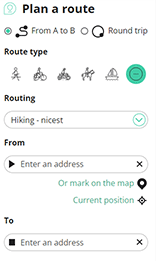
With RouteYou, it's easy to create your own customised maps. Simply plot your route, add waypoints or nodes, add places of interest and places to eat and drink, and then easily share it with your family and friends.
Route planner
<iframe src="https://plugin.routeyou.com/poiviewer/free/?language=en&params.poi.id=3191758" width="100%" height="600" frameborder="0" allowfullscreen></iframe>

More than 10,100,000 routes

More than 15,000,000 users

More than 4,500,000 points of interest

Kerkstraat 108
9050 Gentbrugge, Belgium
© 2006-2026 RouteYou - www.routeyou.com