Source: Schlusmans, Frieda, 23-05-1979, ©Vlaamse Gemeenschap
Copyright: All rights reserved


The so-called 'Kluyskensmolen', 'Kleeskensmolen' or 'Klaaskensmolen' was established in the 16th century as an oil mill, but has also served as a sawmill since the early 20th century. History The Kluyskensmolen was first mentioned as an oil mill in 1545. This is probably also the period when the mill was established. The water mill is marked on the Ferraris map (1771-77) and in the Atlas of Local Roads (1845). The Permanent Deputation of the province of Limburg approved the established water level of 0.650 meters on July 7, 1848. The then owner was Philippe Peeters-Pendries, who also owned the nearby Neermolen (a still existing grain water mill). In 1914 or 1916, a sawing facility was added, allowing the mill to operate as both a water oil and wood sawmill from then on. The building was enlarged for this purpose. To allow the sawing to start without interruption, a freewheel was created that can be switched on and off with a lever. The municipality of Neeroeteren purchased the mill in 1970 from the Indekeu family. After the merger with the city of Maaseik, the mill was protected (1986) and underwent a thorough restoration starting in 1994, which included renovation of the building, revision of the saw machine, and construction of a new waterwheel. Designers were the Dutch mill specialist Nico Jurgens from Nieuwegein (formerly Veldhoven, Hoorn NL) and architect D. Martens from Genk. The Kluyskensmolen is the last working water-driven sawmill in Flanders. Description The Kluyskensmolen is a water mill of the undershot type. The milling equipment is still present, including the concrete sluice works, the metal waterwheel, all movable parts with a sliding saw, and all accessories. It is a brick building of one floor under a gable roof of mechanical tiles. The facades exhibit wrought-iron wall anchors with curls. The southern part is an open shed on brick pillars. Inside, there is a rectangular door under a wooden lintel. The east facade has a small rectangular window under a wooden lintel and a rectangular door in a wooden frame. Adjacent to the same facade there is an extension under a shed roof. The mill wheel is located in the north facade, which is partially cemented. In the west facade, there is an extension under a shed roof.
Copyright: All rights reserved
 | | Public | Danish • Dutch • French • German • Italian • Spanish
Address: Kleeskensmolenweg 20, Maaseik
Statistics
Select one of the most popular activities below or refine your search.
Discover the most beautiful and popular trails in the area, carefully bundled into appropriate selections.
Source: Schlusmans, Frieda, 23-05-1979, ©Vlaamse Gemeenschap
Copyright: All rights reserved
Select one of the most popular categories below or be inspired by our selections.
Discover the most beautiful and popular attractions in the area, carefully bundled in appropriate selections.
Source: Schlusmans, Frieda, 23-05-1979, ©Vlaamse Gemeenschap
Copyright: All rights reserved
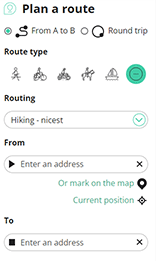
With RouteYou, it's easy to create your own customised maps. Simply plot your route, add waypoints or nodes, add places of interest and places to eat and drink, and then easily share it with your family and friends.
Route planner
<iframe src="https://plugin.routeyou.com/poiviewer/free/?language=en&params.poi.id=3196636" width="100%" height="600" frameborder="0" allowfullscreen></iframe>

More than 11,800,000 routes

More than 15,000,000 users

More than 4,500,000 points of interest

Kerkstraat 108
9050 Gentbrugge, Belgium
© 2006-2026 RouteYou - www.routeyou.com