Source: Schlusmans, Frieda, 01-09-1977, ©Vlaamse Gemeenschap
Copyright: All rights reserved


The station building of Leopoldsburg was built in 1878 for the Camp of Beverlo and expanded in 1929. After the Belgian revolt and the Dutch invasion of Belgium in August 1831, both countries remained in a state of war until the Netherlands accepted the terms of the London Convention in 1838. This protracted conflict with the Netherlands necessitated permanent surveillance of our borders. King Leopold I had to reorganize the army and put it on a war footing. In order to achieve a high degree of operationality, one large training camp, located not too far from the Dutch border, was necessary. In 1835 the construction of the Beverlo camp was approved by parliament and in a minimum of time a permanent camp was built for 20,000 soldiers. As early as August 1835, the first maneuvers took place. Observers from all over the world congratulated King Leopold I on the largest, most modern and most comfortable camp in the world. At the same time as the soldiers, the civilians had also arrived in the camp. They built their huts just behind the infantry camp. They came from all over Belgium but also from across the borders. Although they practiced all kinds of professions, they all had something to do with the catering sector and in the evenings they were all café owners. From 1845 onwards, no new permits were given for housing on the military domain, but the citizens could buy dirt-cheap building land in a subdivision to the west of the camp. On 1 July 1850, this new settlement became the independent communes of 'Bourg-Léopold'. Its very wide streets, rectilinear structure and sidewalks bear the characteristics of a typical military village. Railway station In 1835, for the first time on the European continent, a passenger train ran from Brussels to Mechelen. As early as October 1839, the railways made their appearance in Limburg. First it was the line from Landen to Sint-Truiden, and from 1850 it was used as far as Hasselt. From there, the troops left on foot for Leopoldsburg. On 9 January 1888, the first section of the tram project of the province of Limburg was opened. It was the tram from Leopoldsburg to Bree. This opening took place in a solemn manner and was accompanied by great festivities. The fact that this happened in Leopoldsburg was unmistakably related to the strategic importance of the Camp of Beverlo. This tram line was built to Bree and later extended to Maaseik. This gave Leopoldsburg a privileged position. The Leopoldsburg station building was inaugurated on 27 May 1878 by Mayor Jozef Leonard and in the presence of the Minister of Public Works. Description The station is a wide building of five bays and two storeys under a hipped roof, flanked by two one-storey outbuildings and eleven left-hand bays and two right-hand bays respectively, also under a hipped roof. The masonry is painted and locally occupied. The round-arched wall openings on the ground floor are equipped with interconnected drip mouldings. The arched windows on the upper floor have the same finish. The façade is delineated by a cornice on wooden consoles. Originally, the building was unpainted and the left part only extended over two bays. In 1929 this section was extended to the current eleven bays, including an additional T.T. function. Later, probably just after the Second World War, the interior was modified.
Copyright: All rights reserved
 Azure
Azure | | Public | Danish • Dutch • French • German • Italian • Spanish
Address: Nicolaylaan 40-42, Leopoldsburg
Statistics
Select one of the most popular activities below or refine your search.
Discover the most beautiful and popular trails in the area, carefully bundled into appropriate selections.
Source: Schlusmans, Frieda, 01-09-1977, ©Vlaamse Gemeenschap
Copyright: All rights reserved
Select one of the most popular categories below or be inspired by our selections.
Discover the most beautiful and popular attractions in the area, carefully bundled in appropriate selections.
Source: Schlusmans, Frieda, 01-09-1977, ©Vlaamse Gemeenschap
Copyright: All rights reserved
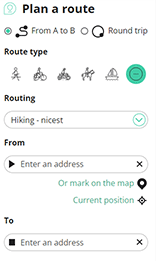
With RouteYou, it's easy to create your own customised maps. Simply plot your route, add waypoints or nodes, add places of interest and places to eat and drink, and then easily share it with your family and friends.
Route planner
<iframe src="https://plugin.routeyou.com/poiviewer/free/?language=en&params.poi.id=3205576" width="100%" height="600" frameborder="0" allowfullscreen></iframe>

More than 11,800,000 routes

More than 15,000,000 users

More than 4,500,000 points of interest

Kerkstraat 108
9050 Gentbrugge, Belgium
© 2006-2026 RouteYou - www.routeyou.com