Source: Blauwkruikje


Petit came from a poor family of tax collectors. When her mother died, her father placed Gabrielle and her sister in an orphanage. At fifteen, she had to leave school. She went to live in Brussels, where she worked in shops and bars. As a single woman, it was not an easy life. She was often depressed and attempted suicide.
War
When the First World War broke out, she was engaged to a soldier. He was injured at the front and escaped from captivity. She helped him flee to the Netherlands to rejoin the Belgian army on the other side of the front. Since she could not fight by his side as a woman, she wanted to become a nurse and volunteered for the Red Cross. In Folkestone, she was recruited by the British intelligence service Wallinger London.[1]
In England, she received a brief training to prepare her for railway espionage. In July 1915, she was back in Brussels. She relayed German troop movements by rail to the Allies. Using disguises, she traveled through Belgium and Northern France. The German secret police apprehended her but released her due to a lack of evidence. She continued under the alias Legrand (the great, the reverse of her real name). She wrote reports on small sheets of tissue paper that she hid in her clothing. She had to find couriers herself and knew that this was very risky because the Germans paid their infiltrators well.
The trap closes
On February 2, 1916, she fell into the trap. She was betrayed, arrested, and sentenced to death for "treason consisting of espionage" after a trial behind closed doors. She refused to sign a plea for clemency, even though the French spy Louise de Bettignies had obtained clemency. In the Prison of Saint-Gilles, she wrote on the wall: "I do not ask for mercy, to show the German that I wipe my feet on him." From prison, she wrote to her sister Hélène ("I will show them how a Belgian woman knows how to die") and to her godmother ("no blindfold"). On April 1, 1916, she was executed by firing squad at the National Shooting Range in Schaerbeek.
Remembrance
Petit’s death caused more commotion than the Germans had expected, although most Belgians did not learn of the news until after the war. In occupied Brussels, the later Cardinal Cardijn held a Te Deum in her honor for a full Saint Gudula Cathedral. In a defamation campaign, the Germans claimed that she had done it for money and had prostituted herself.
After the war, a cult arose around Petit. Her cell in the Prison of Saint-Gilles served for a time as a place of recognition and was kept empty until 1986. The original cell door has been preserved to this day. Her body was reburied in May 1919 at the Cemetery of Schaerbeek in the presence of Queen Elisabeth. In 1923, she received a monument in Brussels' Saint John's Square, which was ceremonially inaugurated. The work of Egide Rombaux (1865-1942) was the first statue for a working-class woman on European soil. A statue was also erected in her hometown.
In 2005, she was nominated for the title The Greatest Belgian in both Flanders and Wallonia. In the Walloon version, she ended up at number 85 and in the Flemish version at number 94. source: wikipedia
 | | Public | Danish • Dutch • French • German • Italian • Spanish

Select one of the most popular activities below or refine your search.
Discover the most beautiful and popular trails in the area, carefully bundled into appropriate selections.
Source: Blauwkruikje
Select one of the most popular categories below or be inspired by our selections.
Discover the most beautiful and popular attractions in the area, carefully bundled in appropriate selections.
Source: Blauwkruikje
With RouteYou, it's easy to create your own customised maps. Simply plot your route, add waypoints or nodes, add places of interest and places to eat and drink, and then easily share it with your family and friends.
Route planner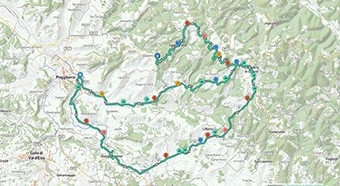
<iframe src="https://plugin.routeyou.com/poiviewer/free/?language=en&params.poi.id=7479292" width="100%" height="600" frameborder="0" allowfullscreen></iframe>

More than 11,800,000 routes

More than 15,000,000 users

More than 4,500,000 points of interest

Kerkstraat 108
9050 Gentbrugge, Belgium
© 2006-2026 RouteYou - www.routeyou.com