Source: Jan Rymenams
Already since 1798, groups could rent the Jardin Saint-Georges garden, install festive lighting, and organize a concert, for which they would close the public road and charge an admission fee. Leuven already had a kiosk in the ‘city park’ laid out by Rosseels in 1844 at the Tiense vest near the current station. In his park plan of 1868, a kiosk was also provided. After the filling of the dry moat, a kiosk was erected in 1835 resembling a Chinese pagoda. During that period in Leuven, the concert association was the Société de l’Académie. Annually, between May and September, it held about six concerts. On Monday, September 6, 1852, at 7 p.m., on the occasion of the fair concert, the avenue was illuminated while in the garden, during the break, electric light was turned on.
Apparently, there was little enthusiasm regarding the sound quality of the old kiosk. In Rosseel’s plan, a ‘little hill’ was provided on which a new kiosk would be built. The design was by city architect and engineer Eugéne Frische, a specialist in iron constructions. With his peculiar design, Frische deliberately met the requirements for good acoustics, but he realized that the design was consequently constrained. He himself referred to his construction as a ‘reflector of sounds’.
The cast work was by the well-known company J.C. Van Aerschot from Herentals. The kiosk was inaugurated in 1898 with a performance by the Société royale de l’Académie de Musique.
Also notice the beautiful gas burners to illuminate the kiosk.
Background of the kiosk
Kiosks were already known to us in the 17th century, and the idea has Eastern origins, namely a garden pavilion that is open on all sides. The word kiosk actually comes from the Turkish “köşk”. They were initially placed in private gardens and parks. However, the music kiosk as a stage for musicians became fashionable around 1830. It was first the military bands that wanted to provide a pleasant respite for urban residents in this way. This often still happened on temporary wooden kiosks that could be set up and taken down. Halfway through the 19th century, brass bands and harmonies emerged. They not only paraded through towns and cities but also went to ‘perform’ on kiosks. The kiosks became permanent and appeared in squares or parks. In a certain sense, it was a democratization. They also became structures of particular beauty and presence.
The kiosk not only served to provide musicians with a roof over their heads against rain or bright sun. They were positioned slightly higher than the crowd so that people could see the musicians and the sounds were spread over their heads. To enhance that effect and prevent the sound from being lost in the heavenly clouds, the ceiling also served as a ‘soundboard’.
Especially after World War II, the kiosks were dismantled: not only was the juke-box a contributing factor, but primarily the fact that cars demanded parking spaces.
Source: Jan Rymenams
 | | Public | Danish • Dutch • French • German • Italian • Spanish

Select one of the most popular activities below or refine your search.
Discover the most beautiful and popular trails in the area, carefully bundled into appropriate selections.
Source: Jan Rymenams
Select one of the most popular categories below or be inspired by our selections.
Discover the most beautiful and popular attractions in the area, carefully bundled in appropriate selections.
Source: Jan Rymenams
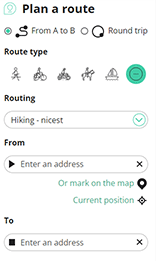
With RouteYou, it's easy to create your own customised maps. Simply plot your route, add waypoints or nodes, add places of interest and places to eat and drink, and then easily share it with your family and friends.
Route planner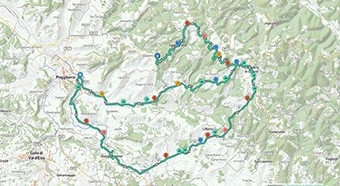
<iframe src="https://plugin.routeyou.com/poiviewer/free/?language=en&params.poi.id=8543478" width="100%" height="600" frameborder="0" allowfullscreen></iframe>

More than 10,100,000 routes

More than 15,000,000 users

More than 4,500,000 points of interest

Kerkstraat 108
9050 Gentbrugge, Belgium
© 2006-2026 RouteYou - www.routeyou.com