When the Morville menhir was discovered by William Livermore, a local prospector, it was barely above the ground. He was released in 1995. The block stood on the edge and fit perfectly into the main line of the megalithic field. It is a maximum of 80 cm high and 28 cm thick.
Several secondary structures were observed around the boulder: six wedges of puddingstone around the base and the often faint traces of a founding pit. An ellipsoidal pavement measuring approximately 6 feet by 30 inches was discovered 15 inches southwest of the block, consisting of small blocks and boulders of puddingstone, quartzite, limestone, and sandstone.
No archaeological material was found. At the end of the excavation, the menhir was moved 4 m to the south-southwest to be placed at the edge of the farmer's path. In this way, work in agriculture is no longer hindered and it comes into its own better.
 | | Public | Catalan • Danish • Dutch • French • German • Italian • Spanish
Address: Durbuy, Waals Gewest, Belgium
Statistics
Select one of the most popular activities below or refine your search.
Discover the most beautiful and popular trails in the area, carefully bundled into appropriate selections.
Select one of the most popular categories below or be inspired by our selections.
Discover the most beautiful and popular attractions in the area, carefully bundled in appropriate selections.
With RouteYou, it's easy to create your own customised maps. Simply plot your route, add waypoints or nodes, add places of interest and places to eat and drink, and then easily share it with your family and friends.
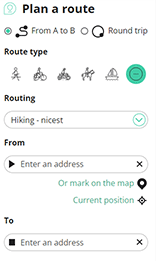
Route planner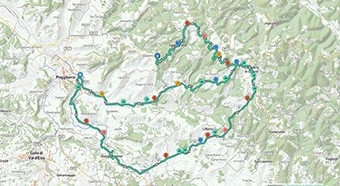
<iframe src="https://plugin.routeyou.com/poiviewer/free/?language=en&params.poi.id=8591628" width="100%" height="600" frameborder="0" allowfullscreen></iframe>

More than 11,800,000 routes

More than 15,000,000 users

More than 4,500,000 points of interest

Kerkstraat 108
9050 Gentbrugge, Belgium
© 2006-2026 RouteYou - www.routeyou.com