Source: Willem Vandenameele


Tournai station was built in 1875 on land cleared after the dismantling of the city walls.
It is particularly representative of railway architecture in Belgium and its development at the end of the 19th century. Built according to the plans of architect Henri Beyaert, in neo-Renaissance style, it has a grandiose design . It is 118 meters long and 19 meters wide . It consists of two very elongated wings, sandwiched between an imposing central pavilion dated on the entablature, crowned on the roof by a bell and two pavilions with smaller angles.
The station was virtually destroyed in 1944 by several Allied air raids targeting railway installations as part of Operation Fortitude. As an almost unique case in the history of the Belgian railways, an identical reconstruction of the beautiful building from 1879 was chosen, although the interior layout was modernized.
The first train arrived in Tournai on January 24, 1842 . The first station in Tournai was located near the Pont des Trous , on the Quai de l'Arsenal (current Quai Andreï Sakharov) beyond this bridge. It had a few tracks, most of which were very short, and a locomotive repair shop just at the foot of the bridge. From 1865 onwards, this small dead-end station, which no longer offered expansion options, had to be moved. After approximately thirty years of service, the building was dismantled and rebuilt in Leuze-en-Hainaut to also serve as a station.
Source: Willem Vandenameele - Wikipedia
 | | Public | Catalan • Danish • Dutch • French • German • Italian • Spanish

Select one of the most popular activities below or refine your search.
Discover the most beautiful and popular trails in the area, carefully bundled into appropriate selections.
Source: Willem Vandenameele
Select one of the most popular categories below or be inspired by our selections.
Discover the most beautiful and popular attractions in the area, carefully bundled in appropriate selections.
Source: Willem Vandenameele
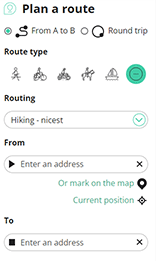
With RouteYou, it's easy to create your own customised maps. Simply plot your route, add waypoints or nodes, add places of interest and places to eat and drink, and then easily share it with your family and friends.
Route planner
<iframe src="https://plugin.routeyou.com/poiviewer/free/?language=en&params.poi.id=8649572" width="100%" height="600" frameborder="0" allowfullscreen></iframe>

More than 11,800,000 routes

More than 15,000,000 users

More than 4,500,000 points of interest

Kerkstraat 108
9050 Gentbrugge, Belgium
© 2006-2026 RouteYou - www.routeyou.com