
The 200th anniversary of the Battle of Waterloo, one of the key moments of the 19th century, was celebrated on June 18, 2015. If the fate of arms on the dreary plain, which is the most famous in the world, had looked different, what would have become of the fate of Europe? We suggest a walk in the footsteps of the Emperor in 1815, between Waterloo and Hestrud, at the French border.
The Walloon region has marked a tourist route titled "in the footsteps of Napoleon in Wallonia", which allows travelers to trace the path taken by the imperial troops and Napoleon I in the days leading up to the battles of Ligny and Waterloo. That is, during the famous "Hundred Days," when he regained his throne; one of those completely unpredictable turns that history has to offer. But let's get to our walk…
We have reworked this route, on one hand, to travel it in the reverse direction, starting in Waterloo – this for simple practical reasons – and on the other hand, to make it enjoyable to ride by motorcycle, on as winding roads as possible. In particular, we have omitted the passage through the city of Charleroi.
The Lion Village
The starting point of the beautiful Belgian walk that we offer you this March is therefore the Lion of Waterloo, which, as everyone knows, is located in the territory of the municipality of Braine-l'Alleud. If history retained the name Waterloo, it is because the Duke of Wellington wrote his victory bulletin in the Auberge Bodenghien, which lies in the heart of the village of Waterloo, although most of the fighting actually took place more on the side of Mont-Saint-Jean and Plancenoit further south.
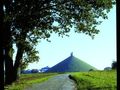
Nowadays, there are about 124 places named Waterloo around the world. These places were mostly established by British veterans who were offered small plots of land in the colonies. As for the Lion Hill, whose origins date back to 1826, it was originally called "Monument to the Dutch." It is 40 m high and requires climbing 226 steps to reach the summit, where a cast lion, the symbol of the Allies' victory, reigns.
This lion looks threateningly towards France. We all learned that in school! The site of the lion was under construction during our visit. A brand new monument was inaugurated for the 200th anniversary of the battle in June 2015. The famous panorama of the battle, a traditional destination for countless school trips, was also restored. The place to be, to express it in Wellington's words!
During our exploration, the site had nothing appealing, anyway. So we hurried to disappear and head south. After passing the Prussian monument – try to decipher the inscriptions in Gothic script! – and the Wounded Eagle, a monument honoring the last fighters of the Grande Armée, the "last square" of the French troops, our route makes a pause at the Caillou farm in Vieux-Genappe, which houses a small museum in honor of the Emperor. There, among other things, one can see one of his field beds. Here, Napoleon and his staff spent the night of June 17, 1815, on the eve of the battle (open daily from 10 am to 5 pm, more information at www.drnier-qg-napoleon.be).
The BBB route then takes some liberties with the official "Napoleon Route in Wallonia." Just for the fun of riding, we reach Glabais, racing down to Maransart in the Lasne valley. It winds pleasantly before climbing back up to Sauvagemont, then to the quiet village of Céroux, known for its beautiful tree-lined square, from which hot air balloons regularly take off in the summer. This detour on the small roads of the Roman Païs in Brabant leads us further towards Court-Saint-Etienne and Villers-la-Ville. Does one still need to introduce the abbey, whose majestic ruins are one of the most beautiful architectural sites in Europe?
Napoleon's Last Victory
We then reach the N5, which is heavily monitored by radar (beware!) and leave it at the roundabout of "Quatre-Bras" in Baisy-Thy. Here, fighting took place on June 16, 1815, at the same time as the conflict between the French and Prussians in Ligny. Ligny, here we come… Ligny is the Emperor's last victory, and the name of this small village in the Namur region stands prominently on the Arc de Triomphe in Paris. Ligny was anything but a small battle. The troops deployed were of the same scale as those assembled at Austerlitz, which says it all.
It was also a military turning point, for although the Prussian army was heavily hit in the center, it managed to save its flanks, which retreated neatly back to Wavre. Napoleon had to send the 30,000 men of Marshal Grouchy after them, whose absence would painfully cost him on the battlefield of Waterloo on June 18… After this, we reach Fleurus and its town hall (former peace castle), where Napoleon overnighted. Soon we should be able to visit a reconstruction of the room where the Emperor slept… It should be noted that Fleurus was the scene of three French victories at different times: that of 1690, which was gained by the troops of Marshal Luxembourg over a coalition that included almost all of Europe, that on June 26, 1794, when the French revolutionaries tore apart the Dutch-Austrians, and finally that of June 16, 1815, two days before Waterloo.
The Green Outburst
The Napoleon route in Wallonia goes through Charleroi. However, not much remains of the Charleroi that was traversed by Napoleon's troops, as their passage occurred before the industrial revolution, which made the city one of the great economic centers of Belgium, which did not yet exist. This upswing is also not entirely alien to Napoleon, as his imperial decree of April 21, 1810, facilitated the large-scale exploitation of coal. We decided to bypass the Charleroi agglomeration from the east, via Wanfercée-Baulet, which we cross before reaching the so-called "Basse-Sambre" road. An approximately 12 km long "Purgatory," where one must drive at 90 km/h or less, we are sorry! Here too, beware of speed checks, which are very frequent.
The section we tackle next, over Vitrival, Le Roux, and Presles, proves to be very pleasant and much greener. Chlorophyll is good for health, just as it is for morale! In Gerpinnes, we park the motorcycles to have a bite to eat at "Sambre-et-Meuse," an essential spot in the city where the memory of the Napoleonic era is very present.
The neighboring brewery, the Brasserie de l'Hôtel de Ville, is indeed home to the Zouaves train of the Gerpinnes society, a hiking association that participates every year in the Marche de Sainte-Rolende, one of the famous marches of Entre-Sambre-et-Meuse, which the local population cherishes. "These marches are often mistakenly referred to as Napoleonic marches," explains a prominent figure from Gerpinnes who is himself a piper in a hiking group. "It is true that the costumes of the hikers come from the Napoleonic era, but these marches have no military character and thus have no connection to Napoleon's passage through the region." And that says it all.
It is now time to reach Jamioulx (today mainly known for its prison), where we find the memory of Napoleon's passage once again. The latter was recognized by the then priest, Abbé Jénicot, who reportedly offered him a glass of Chambertin, his favorite wine. Impressed by the clergyman's conversation, the Emperor supposedly promised to make him the next bishop of Tournai. The defeat at Waterloo put an end to this plan…
The Mandarine… Napoleon
The passage through Thuin and its hanging gardens (however, this has nothing to do with those of Babylon…) is always a pleasure. In any case, it is the pleasantest detour, from a motorized perspective, to get to Ragnies, a charming rural village, proud to be among the "most beautiful villages in Wallonia." Ragnies is home to the Biercée distillery, located in a beautiful square building, the Cour yard, and is well worth a visit (www.distilleriedebiercee.com).
As the only Walloon distillery for fruit brandies and liqueurs, the company is primarily known for its excellent Eau de Villée, a lemon liqueur of remarkable finesse. Recently, the distillery has also started producing the famous Mandarine Napoléon, created in 1892 by a Belgian chemist as a tribute to the Emperor, who allegedly liked to mix mandarin juice with his cognac…
Our next stop will be in Leers-et-Fosteau. Overlooking the surrounding meadows, the castle of Fosteau is an imposing house, with origins dating back to the 14th century. In this very beautiful estate, which is presented by its owners with great friendliness and many historical details, General Reille, chief of Napoleon's 2nd Corps, set up his headquarters on June 15, 1815. Another stop that fits the theme of this walk… The small pharmacy museum housed here is also noteworthy.
Beaumont is not far off. Here, Napoleon and his troops set up their first bivouac on June 14, 1815, at the foot of the 34 m high Salamander tower, which was part of the city's old fortifications. Hestrud, through which Napoleon entered Belgium, is only 8 km away. Nestled in the Thure valley, this small village on the Franco-Belgian border houses an interesting customs museum, located in the former border station, and its barrier has been preserved… but is still raised today. The last kilometers of this BBB will take you into the Thure valley, which will reward you with some lovely curves on good French asphalt to end the ride in style. Safe travels, good discoveries, and always pay attention to your safety!
---
Gastronomic Stops
- In Gerpinnes, the Sambre-et-Meuse is an absolute must, which we have recommended to you before. We're doing it again today. Located right next to the church, this tavern-restaurant offers a pleasant bistro cuisine and recommended pizzas. Open daily, except Tuesdays.
Info: www.lesambreetmeuse.be
- In Hestrud, on the Franco-Belgian border, the friendly café-restaurant of the museum, located in the premises of the equally friendly (and interesting) customs museum, is a small bistro-restaurant in deep France, where one comes for an aperitif and enjoys simple and completely unpretentious cuisine (yes, Andouillette is available!), but at very, very affordable prices (lunch menu for €11 on weekdays). Info: www.cafemuseedeladouane.fr
- At the end of this walk, "Le Canari" in the hamlet of Reugnies (Cousolre) is the ideal place to recharge at the end of the day. Simple and good cuisine, nice ambiance, cozy atmosphere, uncomplicated welcome, large parking area for motorcycles… A small hexagonal restaurant, just how we like it. Try the Martiflette (Tartiflette with Maroilles) and the Anorien-Escavêche, among other things. And the Andouillette, of course (we are a fan!). The only downside: It is only open from Thursday to Sunday. Check the opening hours before setting off.
Info: www.lecanari.fr
Source: Moto80
See something wrong on this route?Add an issue
Navigate route in...
 RouteYou app Open
Don't want to see this ad anymore?
→ Upgrade now

Please wait, the navigation is being prepared.
You can now navigate. Have fun on the road!
Processing your request has failed. Please try again.
Don't want to see this ad anymore?
→ Upgrade now
Please wait, your download is being prepared.
Your download is ready. Have fun on the road!
Processing your request has failed. Please try again.
Don't want to see this ad anymore?
→ Upgrade now
Please wait, your print is being prepared.
Your print is ready to download. Have fun on the road!
Processing your request has failed. Please try again.
<iframe src="https://plugin.routeyou.com/routeviewer/free/?language=en&params.route.id=6802911" width="100%" height="600" frameborder="0" allowfullscreen></iframe>
<p><a class="routeYou_embed" href="https://app.routeyou.com/en-be/route/view/6802911?utm_source=embed&utm_medium=article&utm_campaign=routeshare&navigation=external" title="Beautiful Belgian Walk: 150 km from Waterloo to Hestrud - In the footsteps of Napoleon in Wall - RouteYou" target="_blank"><img src="https://image.routeyou.com/embed/route/960x670/6802911-en@2x.png" style="width: 100%; height: auto;" alt="Beautiful Belgian Walk: 150 km from Waterloo to Hestrud - In the footsteps of Napoleon in Wall"></a></p>
Additional feedback:
This feature is only available to RouteYou PREMIUM subscribers.
Try 1 month for free and discover the difference! We don't take any payment details, and your trial ends automatically after one month.
© 2006-2026 RouteYou - www.routeyou.com



 Chaid
Chaid






 Start
Start Download
 Download

