The Palais de Justice, built on the site of the former Seneschaussée in the 19th century during a period of urban expansion, perpetuates the administrative function of the upper town.
With its façade aligned with the Place de la Résistance , it uses the classical architectural language common to this type of public building. Continuing the judicial function of the site, the Palais de Justice is the successor to the Royal Seneschaussée created after the County of Boulogne became part of the Kingdom of France in 1478. Like more than half of all courthouses in France, this building was built in the 19th century. This golden age of judicial architecture was part of the reform of the legal system after the Revolution , which saw the creation of courts of first instance in each arrondissement. For the city of Boulogne, it was also a period of strong economic and demographic growth, during which many public facilities were built.
The department began the project in 1845 and the palace was inaugurated in 1852. It was entrusted to the department's architect, Firmin Epellet (1807-1889), who had an academic background. His design was inspired by the Laval town hall built in 1833 by Alphonse de Gisors.
The building is a large cubic volume against the rampart. The facade has two levels, punctuated by Doric and Ionic orders. It has a central body with large arched windows surmounted by a triangular pediment . On the tympanum is an allegory by Louis-Victor Bougron (1798-1886) representing Law , surrounded by Strength and Justice , and protecting the Arts, Sciences, Commerce and Industry.
Later, statues of Charlemagne and Napoleon were added. In the hall, a monumental staircase leads to the first floor to the Salle des Pas Perdus , with its imposing barrel vault and two canopies covering the courtroom, which has a flat vault with coffers.
In the 1970s, the Palace of Justice was thoroughly restored, uncovering part of the 2nd century castrum , including a quadrangular tower that is still partially preserved in the basement. The building has recently been restored to its former glory.
Source: Willem Vandenameele
 | | Public | Catalan • Danish • Dutch • French • German • Italian • Spanish

Select one of the most popular activities below or refine your search.
Discover the most beautiful and popular trails in the area, carefully bundled into appropriate selections.
Source: Wikimedia
Select one of the most popular categories below or be inspired by our selections.
Discover the most beautiful and popular attractions in the area, carefully bundled in appropriate selections.
Source: Wikimedia
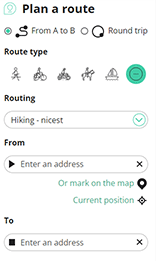
With RouteYou, it's easy to create your own customised maps. Simply plot your route, add waypoints or nodes, add places of interest and places to eat and drink, and then easily share it with your family and friends.
Route planner
<iframe src="https://plugin.routeyou.com/poiviewer/free/?language=en&params.poi.id=8990101" width="100%" height="600" frameborder="0" allowfullscreen></iframe>

More than 11,800,000 routes

More than 15,000,000 users

More than 4,500,000 points of interest

Kerkstraat 108
9050 Gentbrugge, Belgium
© 2006-2026 RouteYou - www.routeyou.com