The Church of Saints Hippolytus and Lawrence is the most important example of late Baroque in Faenza, with explicit references to Roman Baroque, and moreover anticipates the neoclassical style, showing some Venetian influences. Today, the Church of Saints Hippolytus and Lawrence is a parish church, but initially, between 1200 and 1300, it was established as a Benedictine monastic complex, later Camaldolese, directly dependent on the monastery of Murano. The monastery, settled in Faenza since the 12th century, was located almost by the banks of the Lamone River outside the medieval walls. Nothing is known about the appearance of the church and the convent at that time. Even today, the archives of the Faenza church are located precisely in Camaldoli, having been a sacred building linked to the congregations of Tuscan friars spread throughout the surrounding territory. Unfortunately, there are no testimonies of the 13th-century church except for the painting of the Madonna and Child dating back to the 1960s, which is now in the sacristy. What can be admired today is, instead, the 18th-century church. The previous structure was expanded between 1771 and 1774, when new foundations were added to build a larger building based on a design by an unknown author, but certainly Roman. It seems that the same preparatory design came directly from Rome, as the monks had to follow the directives of the higher orders they depended on and adopt a similar orientation in all their churches. It is certain that there was a master builder overseeing its construction: the name of the young Giuseppe Pistocchi, a Faenza architect who built the Teatro Masini and Palazzo Milzetti also in Faenza, has been mentioned, or the Faenza-born Gioacchino Tomba. This reconstruction occurred because during the 18th century, some orders in Faenza decided on a substantial architectural renewal that had to include the pre-existing churches such as San Francesco, Sant'Agostino, the church of the nuns of Sant’Umiltà, the church of the Holy Trinity in Borgo Durbecco, San Domenico, San Benedetto, Santa Chiara. These Gothic and Romanesque three-nave buildings were generally transformed into a single nave due to the invention of the plastered cane vault. Thus, a large part of the churches in Faenza, located not in the historic center - like, for example, the Cathedral of the city - but in the surrounding areas, underwent some structural modifications, aligning with the taste of the prevailing 18th century. In addition to the master builder, a host of plasterers and sculptors surely collaborated: the most significant aspect is undoubtedly all the immense decoration. If one looks at the architectural structure, in fact, it can be noted that it is never free; both the columns and the pilasters conclude at the top with luxurious capitals.
Source: Wikipedia.org
Copyright: Creative Commons 3.0
 | | Public | Danish • Dutch • French • German • Italian • Spanish

Select one of the most popular activities below or refine your search.
Discover the most beautiful and popular trails in the area, carefully bundled into appropriate selections.
Source: Controllore Fiscale
Copyright: Public domain
Select one of the most popular categories below or be inspired by our selections.
Discover the most beautiful and popular attractions in the area, carefully bundled in appropriate selections.
Source: Controllore Fiscale
Copyright: Public domain
With RouteYou, it's easy to create your own customised maps. Simply plot your route, add waypoints or nodes, add places of interest and places to eat and drink, and then easily share it with your family and friends.
Route planner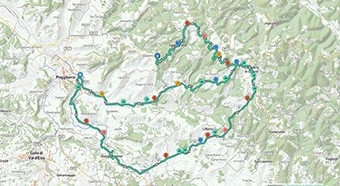

<iframe src="https://plugin.routeyou.com/poiviewer/free/?language=en&params.poi.id=8361394" width="100%" height="600" frameborder="0" allowfullscreen></iframe>

More than 11,800,000 routes

More than 15,000,000 users

More than 4,500,000 points of interest

Kerkstraat 108
9050 Gentbrugge, Belgium
© 2006-2026 RouteYou - www.routeyou.com