Levee breaches usually occur at weak points in the levee that can arise from poor maintenance or through seeping. Seeping (the emergence of groundwater at the surface) occurs due to an underground water flow from a higher to a lower area. When the water then seeps under a levee, levee material can be washed away.
During levee breaches, the water forcefully rushes into the land behind, creating deep swirling holes (wheels or breaches). Due to the depth of the wheel, the levee cannot be repaired at the same spot. Because the new section of levee has been built around the wheel, the levee along the former Zuiderzee has gradually taken on a winding shape. The twists in the levee often refer to old levee breaches.
When the levee is repaired on the sea side, the wheel is inside the levee. Inside the levee, wheels are visible as small deep pools around which the levee winds.
When the levee is repaired on the land side, the wheel is outside the levee. Outside the levee, wheels are recognizable as bends in the levee.

Select one of the most popular activities below or refine your search.
Discover the most beautiful and popular trails in the area, carefully bundled into appropriate selections.
Select one of the most popular categories below or be inspired by our selections.
Discover the most beautiful and popular attractions in the area, carefully bundled in appropriate selections.
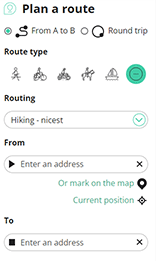
With RouteYou, it's easy to create your own customised maps. Simply plot your route, add waypoints or nodes, add places of interest and places to eat and drink, and then easily share it with your family and friends.
Route planner
<iframe src="https://plugin.routeyou.com/poiviewer/free/?language=en&params.poi.id=8229604" width="100%" height="600" frameborder="0" allowfullscreen></iframe>

More than 11,800,000 routes

More than 15,000,000 users

More than 4,500,000 points of interest

Kerkstraat 108
9050 Gentbrugge, Belgium
© 2006-2026 RouteYou - www.routeyou.com



 | | Public |