Source: Forten.nl


In just nine months, one of the largest bunkers in the Netherlands was built. Construction began in December 1942. The command bunker – from which the German defense of the airspace was coordinated – was given the code name 'Diogenes', just like its predecessor. The Germans named the three command bunkers built in occupied Europe after Greek thinkers. The 'D' of Deelen led to Diogenes. The sister bunker in the German Stade was named Socrates.
From this Division Command Post, the defense of the Dutch, Belgian, and North German airspace was directed. In the center of the three-story bunker was a large hall – due to the thickness of its walls, this hall formed a 'bunker within a bunker' – which was divided in two by a transparent map. On either side of the map were viewing platforms. At the back of the map, Luftnachrichtenhelferinnen – female personnel also known as Blitzmädel – projected the positions of both enemy aircraft and their own fighter planes. On the other side of the map sat the officers who directed their squadrons towards the enemy based on the projected information. In fact, the central space was equipped with a very large screen where, instead of electronics, the Blitzmädel were seated at the back. The Luftnachrichtenlager located to the east of Diogenes II was specifically built for the accommodation of the Blitzmädel. Today, this Ln-Lager forms a creative living and working environment under the name 'Buitenplaats Koningsweg'.
A total of 65,000 m3 of concrete was processed in the building, for which, just like for the reinforcement and formwork, the material was brought in through a special branch from the bomb line to right next to the bunker. The bunker was designed to provide protection against bombings and gas attacks. With an average wall thickness of 3.5 meters, Diogenes II differed enormously from its predecessor Diogenes I, which was built from lightweight materials.
The bunker is built around the main space, which has a height of 14 meters, a width of 15 meters, and a length of 32 meters. Surrounding the large hall, there are about 14 rooms for supporting use on each of the three floors. The bunker had a canteen, an emergency hospital, and a cinema to pass the 'dead hours'. Diogenes II consists of two parts: the bunker itself and the administration building that was added to the east side of the bunker. The walls of the latter are only half a meter thick. For camouflage, the bunker was painted brown and covered with camouflage nets.
Although the Allies were aware of the construction of Diogenes II at an early stage, the central role that the bunker played in German air defense must have escaped them since the Division Command Post itself was never targeted by airstrikes.
On August 15 and September 3, 1944, Fliegerhorst Deelen was bombed and subsequently abandoned by the flying units. The command of the division was then relocated to Duisburg. On the first day of Operation Market Garden (September 17, 1944), the Germans detonated several bombs in the bunker. The bunker served for only nine months, just as long as its construction time.
From January 1947, Diogenes was used not only to store unexploded ordnance but also to detonate munitions in the large hall. From 1954, Diogenes took on various functions such as a support depot of the National Archive, archive of the municipality of Arnhem, and the depot of the Netherlands Open Air Museum. Since 2021, the bunker has no longer had a function, and a new purpose is currently being sought.
Source: Forten.nl
 | | Public | Danish • Dutch • French • German • Italian • Spanish
Address: Koningsweg 13 C, Arnhem
Statistics
Select one of the most popular activities below or refine your search.
Discover the most beautiful and popular trails in the area, carefully bundled into appropriate selections.
Source: Forten.nl
Select one of the most popular categories below or be inspired by our selections.
Discover the most beautiful and popular attractions in the area, carefully bundled in appropriate selections.
Source: Forten.nl
With RouteYou, it's easy to create your own customised maps. Simply plot your route, add waypoints or nodes, add places of interest and places to eat and drink, and then easily share it with your family and friends.
Route planner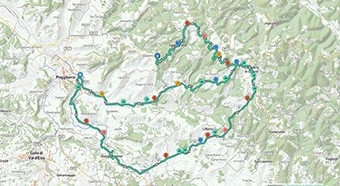
<iframe src="https://plugin.routeyou.com/poiviewer/free/?language=en&params.poi.id=8783390" width="100%" height="600" frameborder="0" allowfullscreen></iframe>

More than 11,800,000 routes

More than 15,000,000 users

More than 4,500,000 points of interest

Kerkstraat 108
9050 Gentbrugge, Belgium
© 2006-2026 RouteYou - www.routeyou.com