Source: Jan Rymenams
It is interesting to note that this road ran on the territory of Langdorp along the watershed between the Nete and Demer basins. In other words, it follows the highest and driest road in the landscape. This is clearly visible on the Ferraris map from the 18th century.
When we know that this road was traditionally called ‘heirbaan’, its origin can be traced back very far in history, probably as far back as the Romans. In the duchy of Brabant, during the 16th century (Ordinance of Prince Charles in 1510), the name 'heirbaan' could only be used for roads that were 40 feet or about 12 meters wide. All foreign traders were allowed to conduct their commerce only on that road, and there was free passage for sheep and other animals. The traders paid tolls to the Duke of Aarschot. The other roads were owned by the lords of Schoonhoven, Rivieren, and Steen. They could impose tolls on these private roads.
The phenomenon of ribbon development
Until World War II, the settlement along the Mechelsebaan was very limited. The road ran alongside a narrow strip of conifers on the drifting dunes on one side and fields on the other. The drifting dunes widen significantly further on. Development mainly occurred after World War II and represents the most recent and dramatic development in the spread of housing in Flanders, and very specifically in North-Hageland and the Southern Kempen. The villages evolved in the 19th century and early 20th century from cores and hamlets where several houses stood together, to an expansion of those cores and an increase in dispersed settlement. After World War II, we see ribbon development. There is greater wealth. Moreover, state subsidies are strengthened. There is no urbanization policy. There have been no land reserves built up by the government in the villages, allowing the developer to freely build on plots along the road. This is the worst form of development economically and ecologically: stretched utility lines for water, electricity, and sewage, expensive public transport, increased car usage, a maze of boundaries and obstacles for fauna, ...
Source: Toerisme Aarschot
 | | Public | Danish • Dutch • French • German • Italian • Spanish

Select one of the most popular activities below or refine your search.
Discover the most beautiful and popular trails in the area, carefully bundled into appropriate selections.
Source: Jan Rymenams
Select one of the most popular categories below or be inspired by our selections.
Discover the most beautiful and popular attractions in the area, carefully bundled in appropriate selections.
Source: Jan Rymenams
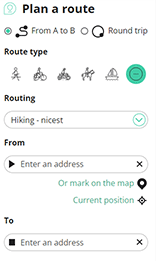
With RouteYou, it's easy to create your own customised maps. Simply plot your route, add waypoints or nodes, add places of interest and places to eat and drink, and then easily share it with your family and friends.
Route planner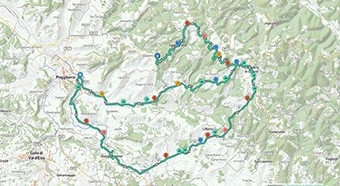
<iframe src="https://plugin.routeyou.com/poiviewer/free/?language=en&params.poi.id=7491869" width="100%" height="600" frameborder="0" allowfullscreen></iframe>

More than 10,100,000 routes

More than 15,000,000 users

More than 4,500,000 points of interest

Kerkstraat 108
9050 Gentbrugge, Belgium
© 2006-2026 RouteYou - www.routeyou.com