Source: Jan Rymenams


A bit of an exceptional sight is this orchard with all the walnut trees. A walnut tree was almost present on every farm. There were several reasons for this. The trees were thought to keep flies away because of their scent. Walnut trees come into leaf quite late. When the trees are in front of the window, the spring sun can still shine into the house, and in the summer, the bright sun is excellently filtered. And of course, the trees produce nuts. This was often seen as a food reserve. The Romans planted them here for that reason near the garrison locations. 25 grams of nuts contain 176 Kcal. Walnut trees were often planned along large dikes to strengthen them.
This was especially the case in the Scheldt region. There, the nuts were bought by the English, and the husks were processed into pickles. During World War I, many walnut trees were cut down because the wood is hard and suitable for gunstocks.
Walnut orchards are quite rare here – unlike, for example, the south of France. It was also not so easy to grow a good tree. Until the 1960s, it was a matter of putting a nut in the ground and hoping it would do well. But from then on, the technique of grafting was fine-tuned. It still takes about 10 years for a tree to start bearing fruit. So, clearly a work of perseverance. Moreover, nothing grows under a walnut tree over time because the trees secrete the toxin 'juglone' through their leaves.
For several decades now, the walnut has been popular in agroforestry. The trees are planted in rows in farmland or as shade trees in grazing pastures. Eric Van de Plas has been searching for old varieties in the Hageland since the 1990s. He has brought the walnut Komeet to market, a large horse nut that is easy to crack and can be stored for a long time.
Source: Jan Rymenams
 | | Public | Danish • Dutch • French • German • Italian • Spanish

Select one of the most popular activities below or refine your search.
Discover the most beautiful and popular trails in the area, carefully bundled into appropriate selections.
Source: Jan Rymenams
Select one of the most popular categories below or be inspired by our selections.
Discover the most beautiful and popular attractions in the area, carefully bundled in appropriate selections.
Source: Jan Rymenams
With RouteYou, it's easy to create your own customised maps. Simply plot your route, add waypoints or nodes, add places of interest and places to eat and drink, and then easily share it with your family and friends.
Route planner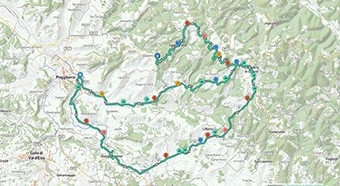
<iframe src="https://plugin.routeyou.com/poiviewer/free/?language=en&params.poi.id=8604630" width="100%" height="600" frameborder="0" allowfullscreen></iframe>

More than 11,800,000 routes

More than 15,000,000 users

More than 4,500,000 points of interest

Kerkstraat 108
9050 Gentbrugge, Belgium
© 2006-2026 RouteYou - www.routeyou.com