Source: Jan Rymenams


When we looked around here 60 years ago, we would have seen many orchards. Especially after World War II, the region became a fruit region. However, this period does not last long. By the 1980s, it was nearly over. By the way, when we look at the map of fruit cultivation from 1929, Hageland is not yet a fruit region at all.
When the pastor of Nieuwrode had to provide a description of the area in 1899—based on a questionnaire from the diocese—he mentions that grains are primarily grown here, namely wheat, 'koorn' (probably rye), oats, and barley, along with potatoes, fodder beets, and other crops for animal feed.
Just before World War I, in 1906, the Verlinden brothers from Gelrode experimented with peaches. During a visit to the Antwerp market, they had seen that a good price was being paid for them. The cultivation took off and spread across the region. Just like with grapes, the soil does not need to be rich; it is only important to have enough warmth and to limit night frost. After all, peaches bloom early, about 14 days earlier than pears. The iron sandstone soil on the southern slopes, which absorbs and slowly releases warmth, is suitable for this. It was a challenge to find the right varieties. Especially in the interwar period, the area under cultivation increased significantly to about 700 hectares in the villages of Gelrode, Nieuwrode, and Wezemaal at its peak in 1960. The production then reached nearly ten thousand tons per year, with the majority being sold in West Germany. The main varieties were Peche de Halle, Charles Ignouf, May Flower, Amsden, Broechemse, and Reine de Verger. The decline was due to cheap imports from Southern Europe and a few disappointing years.
Meanwhile, in the 1930s, a new crop would emerge: strawberries. It was Mayor Jozef Meynaerts of Nieuwrode who brought back some plants of the variety Madame Moutot from Koekelberg. Again, it was a matter of searching for the right varieties, but after World War II, strawberries were cultivated on a large scale and significant money was made. New varieties were even created, such as «Roem van Nieuwrode» and «Wonder van 't Hageland». In many cases, it was a secondary income, often generated by the women who did not work outside the home. The cultivation began to decline in the 1980s, and today there is very little left to see. The reason for the decline was mainly due to taxation, VAT, and the fact that women also went out to work. That income was certainly more secure and easier to earn.
Along with the rise of fruit cultivation, the seasonal market and the auction in Nieuwrode were also established. By 1964, it would have even been the largest fruit market in Europe. Planes were even arranged to fly the strawberries to Scandinavia.
Source: Jan Rymenams
 | | Public | Danish • Dutch • French • German • Italian • Spanish

Select one of the most popular activities below or refine your search.
Discover the most beautiful and popular trails in the area, carefully bundled into appropriate selections.
Source: Jan Rymenams
Select one of the most popular categories below or be inspired by our selections.
Discover the most beautiful and popular attractions in the area, carefully bundled in appropriate selections.
Source: Jan Rymenams
With RouteYou, it's easy to create your own customised maps. Simply plot your route, add waypoints or nodes, add places of interest and places to eat and drink, and then easily share it with your family and friends.
Route planner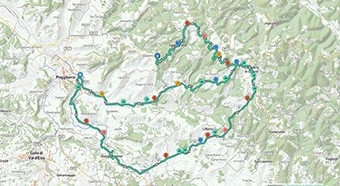

<iframe src="https://plugin.routeyou.com/poiviewer/free/?language=en&params.poi.id=8604643" width="100%" height="600" frameborder="0" allowfullscreen></iframe>

More than 11,800,000 routes

More than 15,000,000 users

More than 4,500,000 points of interest

Kerkstraat 108
9050 Gentbrugge, Belgium
© 2006-2026 RouteYou - www.routeyou.com