Source: Jan Rymenams
At the end of the 19th century, Belgium was crisscrossed by a dense railway network. However, there was a limitation. The lines connected cities, ports, and industrial areas but ignored the agricultural countryside. Not surprisingly, as the railways were operated by private companies and had to be profitable. Therefore, the Belgian state decided to open up the countryside with a network of narrower railways and simple locomotives. The goal was to provide a stop every kilometer. In 1885, the national Company for Local Railways was established. The social subscription was introduced to allow workers to commute to the city, but primarily to keep them under the church steeple. The fares were cheap, even for the transport of agricultural products. Where the tram lines knew about 5 kilometers of rural periphery in the city, this suddenly became 25 kilometers. Trams would provide economic and social cohesion until they were largely replaced by bus services after World War II.
Rummen was located on the line between Herk-de-Stad and Sint-Truiden, thereby having not only a market in those cities but also a connection to Hasselt, Liège, and Brussels.
After 10 years of searching for the much-needed funds, the 17-kilometer line was inaugurated in 1913. It had cost about 64,706 francs per kilometer at that time. It only had a single track, which meant that the schedule of arriving and departing trams had to be precisely adjusted. Most trips were made on Saturdays when there was a market in Sint-Truiden. This was the case at the opening when 160 passengers were transported. It took about half an hour to steam from Rummen to Sint-Truiden. Already in 1948, passenger transport was discontinued. Goods were still transported for a little while longer, but the tracks were dismantled in 1950-1951.
The tram may have had a hard time here, especially towards Herk-de-Stad. After all, we are heading to the highest point of Rummen, and the slope was – certainly in winter – a significant hindrance.
Source: Jan Rymenams
 | | Public | Danish • Dutch • French • German • Italian • Spanish

Select one of the most popular activities below or refine your search.
Discover the most beautiful and popular trails in the area, carefully bundled into appropriate selections.
Source: Jan Rymenams
Select one of the most popular categories below or be inspired by our selections.
Discover the most beautiful and popular attractions in the area, carefully bundled in appropriate selections.
Source: Jan Rymenams
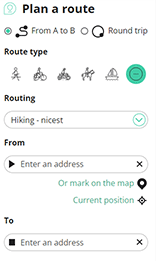
With RouteYou, it's easy to create your own customised maps. Simply plot your route, add waypoints or nodes, add places of interest and places to eat and drink, and then easily share it with your family and friends.
Route planner
<iframe src="https://plugin.routeyou.com/poiviewer/free/?language=en&params.poi.id=9103318" width="100%" height="600" frameborder="0" allowfullscreen></iframe>

More than 11,800,000 routes

More than 15,000,000 users

More than 4,500,000 points of interest

Kerkstraat 108
9050 Gentbrugge, Belgium
© 2006-2026 RouteYou - www.routeyou.com