Source: GroeneHartstocht
Since a distant past, the Utrechtse Vecht has defined the landscape of North-West Utrecht. This river formed a lifeline for the impenetrable forests and marshlands that dominated this part of the Netherlands before our era, and for many centuries afterwards.
In the time of the Roman Empire, the Vecht, which was actually outside the borders of the Roman Empire, was already used as a shipping connection to more northerly areas. However, the surrounding lands remained uncultivated at that time and were only visited by hunters. In such a state it has remained for many centuries until the departure of the Roman armies.
During the early Middle Ages, the land around the Vecht was known as the Shire Niftarlake. It was during this time that the first, still very local, extractions took place. At the end of the 8th century, the Frisian nobleman Wursing lived in Swesen or Suesnon, later Swesereng. The lands had been lent to him by Charles Martel. Wursing must have been a very devout Christian. He was, according to historiography, very good friends with St. Willibrordus and st. Willibrordus. Boniface, and received the earth bishop several times on his estate. A grandson of Wursing was St. Ludgerus to whom in later years the church of a.o. Loenen was ordained. Most likely, the settlement inhabited by Wiirsing and his descendants formed the predecessor of the current House (castle) in Zuilen.
A century later, the surrounding lands appear to have come into the possession of the Utrecht church.
After this period there follows a time of about three centuries of which little is known about the history of Zuilen. At this time, the region was first ravaged by the invading of the Normans, and then, in 839, by a devastating tidal wave that, due to the still very small diking, engulfed large parts of the northern Netherlands. If the settlement had not been destroyed by the Normans in those years, it would certainly have been destroyed by the flood. It is therefore plausible that the land around the current Zuilen was largely uninhabited at that time.
In the 12th century the great extractions started. The lands along the Vecht were dug through with elongated drainage channels and slowly lined with dikes. The land was shared with the riverbank as a guideline, and in the following centuries more and more inland was mined. This created elongated strips of land that are typical for this part of the province of Utrecht (see note 2). Under Bishop Boldewijn van Holland (1178-1196) it was mentioned among the fiefs of the Sticht: 'Die lord van Anholt ende van Zulen, deze hilt te lene van den Sticht dat Casteel en Herrlicheyt van Zulen' (see note 3). In the year 1265, a member of the van Zuylen family was mentioned by name for the first time in the writings. This was Hendrik van Zulen and Anholt. A few years later we also learn something about one Steven van Zuylen who was involved in the siege of the castle Kronenburg in Loenen where the Lord of Velsen was hiding after the conspiracy against Floris V. The castle and the adjacent village owes its name to this family of fiefs. The van Zuylen's in turn received the name of the eponymous village Zulen near the German city of Kleve where the family originated.
In 1300 the current stone castle was built. The year of the foundation can still be found in the side façade of the castle. It is not known whether there was a stone house before 1300 or whether there was a fortress built of wood. This predecessor of the current castle was destroyed around 1297 in revenge for the siege of Kronenburg. Steven van Zuylen was murdered.
 Azure
Azure | | Public | Danish • Dutch • French • German • Italian • Spanish

Select one of the most popular activities below or refine your search.
Discover the most beautiful and popular trails in the area, carefully bundled into appropriate selections.
Source: GroeneHartstocht
Select one of the most popular categories below or be inspired by our selections.
Discover the most beautiful and popular attractions in the area, carefully bundled in appropriate selections.
Source: GroeneHartstocht
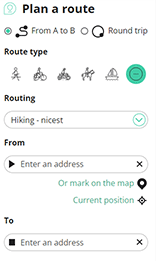
With RouteYou, it's easy to create your own customised maps. Simply plot your route, add waypoints or nodes, add places of interest and places to eat and drink, and then easily share it with your family and friends.
Route planner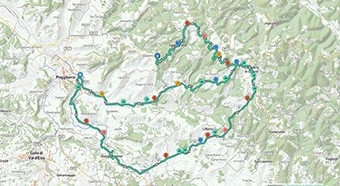
<iframe src="https://plugin.routeyou.com/poiviewer/free/?language=en&params.poi.id=8169803" width="100%" height="600" frameborder="0" allowfullscreen></iframe>

More than 11,800,000 routes

More than 15,000,000 users

More than 4,500,000 points of interest

Kerkstraat 108
9050 Gentbrugge, Belgium
© 2006-2026 RouteYou - www.routeyou.com