Source: Jan Rymenams
From number 32 in Charles Deberiotstraat, we see a trio of houses that all pertain to a remarkable professor and scientist from the transition between the 19th and 20th centuries at the university, namely Henry de Dorlodot (1855-1929). And if we look at what is next to this entrance: ‘MUSÉE HOUILLER’ and the figures of reptiles above the doorframe, we can suspect that it concerns a scientist who has something to do with fossils, coal, and especially: geology.
Henri de Dorlodot, who came from the region of Charleroi, had a special passion for geology, but became a priest at the age of 30 and taught at the seminary in Namur. His knowledge must have been good, as he was appointed as a lecturer in ‘cosmology’ at the Higher Institute of Philosophy of the Catholic University of Leuven as early as 1890. This institute was established by Cardinal Mercier and was meant to provide an answer to the growing belief in science and the accompanying ‘atheism’. Apparently, Dorlodot and Mercier were not on the same page. Dorlodot was known to be a supporter of Charles Darwin's theory of evolution. He found this theory compatible with Catholic doctrine. He maintained contact with the famous theistic evolutionist Pierre Teilhard de Chardin but had a conflict with the church due to his views.
Dorlodot remained deeply interested in geology and published on the subject, and in 1894 he became a professor of geology and paleontology at the Faculty of Sciences.
At first, Dorlodot lived in what we call the Renaer House. The house already dated back to the end of the 18th century. It should therefore not surprise us that in 1896 he commissioned architect Théodore Van Dormael to design a new residence next to the Renaer house. The construction was completed in 1898.
In 1899, he established, at his own expense, a building on the grounds of the Catholic University to house the fossil flora of the coal formations. In 1906, he had the Coal Museum built, designed by architect Vincent Lenertz for the exhibition of the paleontological collection of Jesuit P. Schmitz and his own fossil flora of the coal formations. This would be expanded in 1922 and 1923 by architect Théodore Van Dormael and set up as a ‘didactic workshop’. He transformed the original coal museum and expanded it with reading rooms, workshops, a library, new collections and equipment, and a paleontological museum.
Source: Jan Rymenams
 | | Public | Danish • Dutch • French • German • Italian • Spanish

Select one of the most popular activities below or refine your search.
Discover the most beautiful and popular trails in the area, carefully bundled into appropriate selections.
Source: Jan Rymenams
Select one of the most popular categories below or be inspired by our selections.
Discover the most beautiful and popular attractions in the area, carefully bundled in appropriate selections.
Source: Jan Rymenams
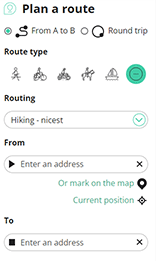
With RouteYou, it's easy to create your own customised maps. Simply plot your route, add waypoints or nodes, add places of interest and places to eat and drink, and then easily share it with your family and friends.
Route planner
<iframe src="https://plugin.routeyou.com/poiviewer/free/?language=en&params.poi.id=8543490" width="100%" height="600" frameborder="0" allowfullscreen></iframe>

More than 10,100,000 routes

More than 15,000,000 users

More than 4,500,000 points of interest

Kerkstraat 108
9050 Gentbrugge, Belgium
© 2006-2026 RouteYou - www.routeyou.com