Source: Schlusmans, Frieda, 01-01-2005, ©Vlaamse Gemeenschap
Copyright: All rights reserved


Former farmhouse with separate components, in U-shape around the yard. The farm is located just behind the Maasdijk, on a piece of land that was spared from the gravel removal; The immediate area was excavated in the 1960s, but replenished. The farm was built on a natural height, so that even a very high water level cannot cause serious damage. The farm also used to function as a skipper's inn, and the owners operated a ferry to Stevensweert (NL), which disappeared in the 1950s. The Houben family, after which the farm is named, is an old family in Kessenich: in the cemetery is the grave cross of Hobricht van Lind (†1678) and his wife Neelken Leurs (†1694), Dirck Houben (†1679) and Ian Houben (†1695). The farm remained in the possession of this family. The origin of the farm probably has to do with the reinforcement of Stevensweert. The city was taken by the Prince of Orange in 1632. The Spaniards recaptured the city and developed it into an advanced fortress on the right bank of the Meuse; a ship's bridge maintained the connection with the other bank, from where the important road through the Kempen to Brabant departed. On a map from before 1633, the map Stevensweert: carte photografie de la terre et chau de Montfort by Ph. Taine, 1623, no building is yet indicated on the site of the current Houbenhof. On the left bank of the Meuse, opposite Stevensweert, the Spaniards planned two redoubts, which were to help defend the ship's bridge. It is not clear whether these redoubts were ever built; It is likely that only the northern redoubt was built, which is mentioned in a deed of 1664. This deed deals with the purchase of a piece of land opposite Stevensweert in 1660 by Aert Houben; It is possible that Aert Houben bought the place where the southern redoubt was planned, as it is an artificially raised piece of land. The same deed of 1664 mentions that Houben had already built a house on the site he had bought; the origins of the Mansion thus go back to the period 1660-64. A deed from the aldermen's bench of Stevensweert shows that an inn was established in the mansion as early as 1681. On H. Frickx's map of 1709 the mansion is depicted under the name Heranthous. The ship bridge had fallen out of use at the end of the 17th century and the crossing was again made by ferry. This ferry was probably operated from the Mansion from the beginning of the 18th century. The local lord, the lord of Walburg, had the right of passage, which he leased to the Houben family. On a Plan of Stevensweert by W.I.S. Marlet of 1734, the mansion is indicated by the ferry and the northern redoubt, next to a road, which is here called the road to Maaseik. The façade stone, now no longer present, with a date of 1759, indicates the reconstruction of the Houbenhof; As is also evident from the architectural style, these are buildings from the middle of the 18th century rather than from the third quarter of the 17th century. On the Ferraris map (1771-77) the farm is indicated with separate components, consisting of the house wing with adjoining stable to the southwest of the yard, and the cross barn to the northwest. She is referred to under the name: Cabaret Erenhuijs. The Maasdijk is shown at its current location; behind it lies a wide, swampy area: the Meuse has since eroded away a large part of this bank. The ferry is signposted, with its destination: the Maaspoort of Fort Stevenswert. The farm is marked on a square, hedged plot, on which there is an orchard. The surrounding landscape consisted of fields. In the Atlas of the Neighbourhood Roads (1845) the farm has its current form: an upstairs room was added to the house perpendicular to the southeast side by the widow C. Houben at the beginning of the 19th century. This renovation is indicated by a plaque in the south-west gable: W C H/1810. The same widow carried out another, less obvious renovation of the house, indicated by a plaque in the façade of the house: ANNO/1804/W C H. A stable was added at right angles to the front façade of the barn; it dates from the first half of the 19th century, possibly from the renovation of widow Houben. The map also shows the diversion of the Maasloop in a northerly direction. The Maasdijk was extended in a northerly direction. As a result of the excavations, the original road that connected the farm to Geistingen disappeared; the farm was located on a kind of spit of land between the gravel lakes and the Maas, and the access road now runs right next to the Maasdijk. The farm was damaged at the end of 1944 and restored in 1945, altering the original wall openings of the house and the adjoining stable. For the rest, the condition as indicated in the Atlas of the Buurtwegen was preserved intact. To the southwest of the yard is the house with adjoining stable. Opposite are stables, attached in a perpendicular wing to the cross barn, which is located northwest of the yard. The dung heap was located in the north corner of the yard. The open, south-eastern side of the yard is enclosed by a wall; A basket-arched entrance gate and an arched pedestrian passage have been recessed. The yard is covered with mesh boulders in a pattern with ditches to facilitate drainage in the event of flooding. In front of the south-east façade of the house (exterior) is a pavement of cobblestones in a geometric pattern of dark and white boulders (early 19th century). Whitewashed brick buildings under gable roofs (Flemish and mechanical tiles) on pecked and in some places cemented plinths. Wrought iron wall anchors, straight and with curls. The south-eastern, perpendicular part of the house is the basement room added at the beginning of the 19th century. Underneath the room is a cellar with pressed brick barrel vault, with a rectangular cellar window in a rectangular limestone frame. The arched wall openings in the house are a renovation from 1945; The windows in the attic also date from this period. The original windows were rectangular in limestone frame. In 1945 the stable adjoining the house was incorporated into the house, and also provided with arched windows. The barn is equipped with slightly projecting buttresses. The original house-stable area has a projecting eaves on wooden braces on the yard side. The west façade of the barn has a roof and wickerwork. Opposite the house is the stable, of one storey; two arched doors on the yard side; side walls with roofs, wickerwork and top pieces. The barn has an arched gate and small, high-set, arched windows, probably a fairly recent addition. Side walls with roof, wickerwork and top piece. Outside the yard, to the north, the bakehouse. Three bays and two storeys under a gable roof (Flemish tiles). Front and rear façade with roofs and wickerwork, the front façade also of top piece. A rectangular door and ditto window in wooden frames in the front façade. The oven disappeared. In front of the farm, on the Maasdijk, is the cast-iron boundary marker 124, according to the usual model, dated 1843 and the coats of arms of Belgium and the Netherlands. Against the south-east façade of the farmhouse, the stone boundary posts were erected, which were removed from the surrounding area when the surrounding area was cleared and collected here by the owner. HENKENS P., History of Kessenich, Kessenich, 1979, 541-544.
Source: Schlusmans, Frieda (2005)
Copyright: All rights reserved
 Azure
Azure | | Public | Danish • Dutch • French • German • Italian • Spanish
Address: Maasdijk 5, Kinrooi
Statistics
Select one of the most popular activities below or refine your search.
Discover the most beautiful and popular trails in the area, carefully bundled into appropriate selections.
Source: Schlusmans, Frieda, 01-01-2005, ©Vlaamse Gemeenschap
Copyright: All rights reserved
Select one of the most popular categories below or be inspired by our selections.
Discover the most beautiful and popular attractions in the area, carefully bundled in appropriate selections.
Source: Schlusmans, Frieda, 01-01-2005, ©Vlaamse Gemeenschap
Copyright: All rights reserved
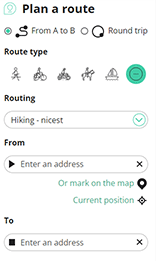
With RouteYou, it's easy to create your own customised maps. Simply plot your route, add waypoints or nodes, add places of interest and places to eat and drink, and then easily share it with your family and friends.
Route planner
<iframe src="https://plugin.routeyou.com/poiviewer/free/?language=en&params.poi.id=3208869" width="100%" height="600" frameborder="0" allowfullscreen></iframe>

More than 11,800,000 routes

More than 15,000,000 users

More than 4,500,000 points of interest

Kerkstraat 108
9050 Gentbrugge, Belgium
© 2006-2026 RouteYou - www.routeyou.com