Source: Jan Rymenams


To put it in context: northeast of Diest, at the 'Saspoort', there is an old weir structure known as the 'Great Buttress'. Just upstream of the Great Buttress, where the Zwarte Beek and the Demer come close together, is the overflow, the "Teerlings", which we have just passed. These constructions were part of the 19th-century defensive belt around Diest. Originally, they were used to supply the city ramparts with water and to be able to quickly flood the Webbekoms Broek in case of danger.
Currently, they no longer have any function. The name is said to come from the roaring sound of a 'bear'. But in fortress terms, a bear is simply a masonry dam in a moat. This is to separate the waters in the canal. The bear was provided with a pointed edge, the so-called donkey's back. Here, the separation is realized by a lock.
The lock construction consists of three openings. The left and right openings are controlled by a spillway, the middle opening by a slide. In principle, a spillway is not adjustable. It holds back the water up to a certain height and is flooded at a higher water level. The slider can be adjusted manually. Its operation is impossible today due to its dilapidated state.
Until the early 1960s, the Demer ran through Diest via the Saspoort, but to avoid flooding, the Demer was diverted via the Walgracht and the Zwarte Beek. Now the river runs completely north of the city. About 500 meters downstream on the right bank, the Demer receives the water of the Zwarte Beek. A few years ago, the bed of the Oude Demer in the centre of Diest was reopened. However, this is not fed by the Demer but by the Begijnebeek.
The Great Buttress, together with the holding basin at Schulen, has a significant influence on the hydraulic regime of the Demer. The Great Buttress provides a backwater of the water upstream of Diest in order to be able to store the water in the holding basin at Schulen if necessary and thus to be able to flatten the peak flow at Diest and the more downstream part of the Demer. The hydrological regime of the Demer is therefore to a large extent influenced by the squeezing effect of the Great Buttress in Diest. This action has made it impossible for fish to migrate upstream into the Demer. This is now remedied by a fish ladder.
Source: Jan Rymenams
 Azure
Azure | | Public | Danish • Dutch • French • German • Italian • Spanish

Select one of the most popular activities below or refine your search.
Discover the most beautiful and popular trails in the area, carefully bundled into appropriate selections.
Source: Jan Rymenams
Select one of the most popular categories below or be inspired by our selections.
Discover the most beautiful and popular attractions in the area, carefully bundled in appropriate selections.
Source: Jan Rymenams
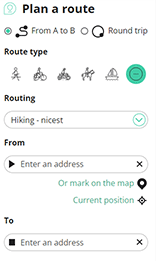
With RouteYou, it's easy to create your own customised maps. Simply plot your route, add waypoints or nodes, add places of interest and places to eat and drink, and then easily share it with your family and friends.
Route planner
<iframe src="https://plugin.routeyou.com/poiviewer/free/?language=en&params.poi.id=8251516" width="100%" height="600" frameborder="0" allowfullscreen></iframe>

More than 11,800,000 routes

More than 15,000,000 users

More than 4,500,000 points of interest

Kerkstraat 108
9050 Gentbrugge, Belgium
© 2006-2026 RouteYou - www.routeyou.com