Source: Pascal Brackman


Purplish is a layer of magmatic rock, infiltrated between older schist rocks, dating back 419 million years.
Here in Lessines, the rock layer, more commonly spelled "sill", is 800 meters thick and about ten kilometers long.
Purplish, beyond its domestic use, gained international fame thanks to the canalization of the Dendre in the mid-17th century. Philip II, King of Spain and sovereign of our regions, ordered works to make the Dendre navigable from Ath to Dendermonde.
René Magritte, born in Lessines, recalls in his work "The Castle of the Pyrenees", the heavy blocks of stone thrown into the air during the explosion of quarry walls.
Purplish is present everywhere in our city, which has earned it the nickname "city of purplish". Much more than a natural wealth, purplish has inspired the lives of the people of Lessines.
It wasn't until the 17th century and the opening of the Caillou-Hubin quarry that the first real exploitation of purplish occurred. The quarries of Lessines were mined in open pit by digging into the ground. A level consisting of a vertical front ledge and a horizontal shelf is created as one descends into the depth. Progress is possible by breaking the stone from the vertical front.
The extraction of purplish in the quarries led to frequent accidents for workers. Many injured would thus be sent to the Notre-Dame à la Rose Hospital to receive the necessary care.
Until the early 20th century, digging holes was done by hand in teams of two men. One holds the mining bar while the other strikes with a hammer. The strength of the rock requires, for paving stones, the use of black powder to avoid pulverizing the stone into small pieces and the use of dynamite for crushed stones. Once the holes are dug, the "breakers" come into action and rough out the stones to facilitate their retrieval to the surface. Even the ground, protected by a simple wooden awning and straw, the shaper molds the paving stones into different shapes. With his tools, he can make squares, road edges, or even mosaics. The unusable pieces for making paving stones and the waste from the crushed works are handled by those called "macadam makers". The production of paving stones will cease in the mid-20th century and the quarries will shift towards the production of crushed stones.
Even today, some quarries continue to exploit purplish.
For others, nature has reclaimed its rights and offers a unique spectacle.
These large holes fill with water and transform into a lake of a magnificent azure blue hue. A belvedere allows one to admire the quarries and their exploitation from the path from Mons to Ghent.
 | | Public | Danish • Dutch • French • German • Italian • Spanish

Select one of the most popular activities below or refine your search.
Discover the most beautiful and popular trails in the area, carefully bundled into appropriate selections.
Source: Pascal Brackman
Select one of the most popular categories below or be inspired by our selections.
Discover the most beautiful and popular attractions in the area, carefully bundled in appropriate selections.
Source: Pascal Brackman
With RouteYou, it's easy to create your own customised maps. Simply plot your route, add waypoints or nodes, add places of interest and places to eat and drink, and then easily share it with your family and friends.
Route planner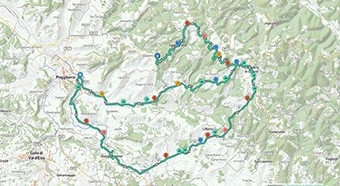
<iframe src="https://plugin.routeyou.com/poiviewer/free/?language=en&params.poi.id=9087488" width="100%" height="600" frameborder="0" allowfullscreen></iframe>

More than 11,800,000 routes

More than 15,000,000 users

More than 4,500,000 points of interest

Kerkstraat 108
9050 Gentbrugge, Belgium
© 2006-2026 RouteYou - www.routeyou.com