The Battle of Hastings was fought on October 14, 1066, between a Norman-French army led by Duke William II of Normandy and an army led by the Anglo-Saxon King Harold II. The battle is named after the English town of Hastings, but actually took place about ten kilometers northwest, where the town of Battle now lies. The outcome of the Battle of Hastings was a decisive Norman victory, the first and most significant step in the Norman conquest of England.
The background to the battle was the death of the childless King Edward the Confessor in January 1066. This led to a succession struggle among several different princes, each claiming the English crown for themselves. Harold Godwinson was crowned king shortly after Edward's death, but soon had to contend with invasions by William, his own brother Tostig, and the Norwegian King Harald Hardrada (Harold III of Norway). Hardrada and Tostig defeated a hastily assembled English army at the Battle of Fulford on September 20, 1066. They, in turn, were defeated by Harold at the Battle of Stamford Bridge five days later. With the deaths of both Tostig and Hardrada at Stamford Bridge, William remained the only serious opponent of Harold. While Harold and his troops were regrouping after the Battle of Stamford Bridge, William landed with his invasion forces at Pevensey in southern England on September 28, 1066. William established a foothold for his conquest of the kingdom. Harold was forced to march south quickly; on the way, he gathered additional troops.
The exact numbers of participants in the battle are unknown; estimates are around 10,000 for William and about 7,000 for Harold. The composition of the armies is clearer; the English army was almost entirely composed of infantry; they had only a small number of archers; the invading force was about half infantry, with the rest evenly divided between cavalry and archers. Harold seems to have tried to surprise William, but scouts from the Norman army were able to locate his army and reported this directly to William, who then marched northwest from Hastings to meet Harold's army at what would later be Battle. The fighting lasted from around nine o'clock in the morning until sunset (late September: around 6:00 PM). Early attempts by the invading force to break through the English lines had little effect; the Normans then used the tactic of feigning a panic retreat, turning around to charge at their pursuers. Harold probably died at the end of the day; this event led to a withdrawal and defeat of most of his army. After moving further into England and having fought a few smaller skirmishes, William was crowned King of England on Christmas Day 1066.
Although there were further uprisings and resistance against William's rule later on, the Battle of Hastings was decisive in the Norman conquest of England. Figures on the number of casualties in the battle are difficult to obtain; however, some historians estimate that about 2,000 Normans were killed and about twice as many Englishmen. William founded an abbey on the site of the battle. The high altar of the abbey church of Battle Abbey is said to be located where Harold was killed.
 | | Public | Danish • Dutch • French • German • Italian • Spanish
Address: Battle, Rother, United Kingdom
Statistics
Select one of the most popular activities below or refine your search.
Discover the most beautiful and popular trails in the area, carefully bundled into appropriate selections.
Source: Barbara van Cleve
Copyright: Creative Commons CC BY-SA 4.0
Select one of the most popular categories below or be inspired by our selections.
Discover the most beautiful and popular attractions in the area, carefully bundled in appropriate selections.
Source: Barbara van Cleve
Copyright: Creative Commons CC BY-SA 4.0
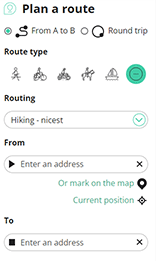
With RouteYou, it's easy to create your own customised maps. Simply plot your route, add waypoints or nodes, add places of interest and places to eat and drink, and then easily share it with your family and friends.
Route planner
<iframe src="https://plugin.routeyou.com/poiviewer/free/?language=en&params.poi.id=1440430" width="100%" height="600" frameborder="0" allowfullscreen></iframe>

More than 11,800,000 routes

More than 15,000,000 users

More than 4,500,000 points of interest

Kerkstraat 108
9050 Gentbrugge, Belgium
© 2006-2026 RouteYou - www.routeyou.com